Author: Zrajm
Created: 2025-08-03 11:49:00+02:00
Updated: 2026-09-13 19:47:47+02:00
License: CC BY-NC-SA (text), GPLv2 (code).
Favicon: pic/favicon.svg
# The Hunt for The Perfect Sign Language Writing System
> An excursion into the world of sign language writing systems, wherein the
> intrepid explorer goes forth, investigates the systems out there and comes to
> many conclusions. (Some of which might even prove helpful!)
>
> This is a guide for the curious, listing and summarizing the writing systems
> out there. They range from systems that only use the Latin alphabet, to
> systems with a completely novel symbol inventory. From detailed transcription
> systems for scientific use, to quick-to-write systems for everyday use.
<toc heading=Contents class=toc upto=1>
-------------------------------------------------------------------------------
# List of Writing Systems
<figure class="sign-language-table table-gui">
<!-- START-TABLE -->
| Year | Title | <p>Latin | <p>Graphemes | <p>Language | <p>Country | Creator | Status |
| ----- | -------------------------------- | -------- | ------------ | ----------- | ---------- | ---------------------------- | --------------- |
| -- | [Gloss] | ● | N/A | any | | -- | ? |
| ? | [Hand Talk Pictographs] | ○ | N/A | PST? | 🇺🇸 | -- | ? |
| 1825 | [Mimography] | ○ | ~190 | LSF | 🇫🇷 | Bébian | hearing |
| 1960 | [Kinemics] | ◑ | ? | PST | 🇺🇸 | West | hearing |
| 1960 | [Stokoe Notation] | ◑ | 55 | ASL | 🇺🇸 | Stokoe | hearing |
| 1965 | [DASL Notation] | ◑ | ? | ASL | 🇺🇸 | Stokoe et al. | hearing & deaf |
| 1971 | [EWMN] | ◑ | ? | ISL | 🇺🇸 | Eshkol; Wachman | hearing? |
| 1974 | [SignWriting] | ○ | >670 | Any | 🇩🇰? 🇺🇸 | Sutton | hearing |
| 1976 | [Friedman--Mandel Notation] (?) | ? | ? | ASL? | 🇺🇸 | Friedman--Mandel? | ? |
| 1977 | [Bergman Notation] | ◑ | ~140 | STS | 🇸🇪 | Bergman | hearing |
| 1980 | [Corazza Notation] | ◕ | ? | LIS | 🇮🇹 | Corazza | deaf |
| 1980 | [IVT Notation] | ? | ? | LSF | 🇫🇷 | International Visual Théâtre | ? |
| 1980? | [SignLettering] | ● | ? | any | 🇺🇸 | Teuber | deaf |
| 1984 | [Farnell Labanotation] | ○ | ? | PST, ASL | 🇺🇸 | Farnell | hearing |
| 1984? | [HamNoSys] | ◔ | 210 | Any | 🇩🇪 | Prillwitz; Vollhaber | ? |
| 1985 | [Kyle & Woll Notation] | ? | ? | BSL? | 🇬🇧 | Kyle; Woll | ? |
| 1987 | [SignFont] | ◔ | ? | ASL | 🇺🇸 | Newkirk | hearing |
| 1988 | [Edinburgh--Durham Notation] (?) | ? | ? | BSL? | 🇬🇧 | ? | ? |
| 1988 | [Radutzky Notation] (?) | ? | ? | LIS | 🇮🇹 | Radutzky | hearing |
| 1989 | [Liddell & Johnson Notation] | ? | ? | ? | 🇺🇸 | Liddell; Johnson | ? |
| 1990 | [D'Sign] | ◔ | ? | LSF | 🇫🇷 | Jouison | hearing |
| 1990 | [Papaspyrou Notation] | ? | ? | any? | 🇩🇪 | Papaspyrou | ? |
| 1990 | [Schermer Notation] (?) | ? | ? | NGT | 🇳🇱 | Schermer | ? |
| 1991 | [Johnston Notation] | ? | ? | Auslan? | 🇦🇺 | Johnston | ? |
| 1991? | [Zaytseva notation] | ◕ | 19 | RSL | 🇷🇺 | Zaytseva | hearing |
| 1992? | [ASL-phabet] | ◔ | 32 | ASL | 🇺🇸 | Supalla | deaf |
| 1993 | [ASCII-Stokoe Notation] | ● | ? | ASL | 🇺🇸 | Mandel | hearing |
| 1994 | [SBM Notation] | ? | ? | LSF | 🇫🇷 | ? | ? |
| 1995? | [FBL Notation] | ●? | ? | Libras | 🇫🇷 🇧🇷 | Ferreira Brito; Langevin | hearing |
| 1996 | [Nève Notation] | ◕ | ? | LSFB | 🇧🇪 | Nève | hearing |
| 1997 | [ASL Orthography] | ● | ~45 | ASL | 🇺🇸 | Low | hearing |
| 1997 | [AusWrite] (?) | ? | ? | Auslan | 🇦🇺? | David Rose | ? |
| 1997 | [ELiS] | ◔ | 90 | Libras/any | 🇧🇷 | Barros | hearing |
| 1997 | [SMYLE] | ? | ? | LSF/any | 🇫🇷 | Pierrat-Frappé | hearing |
| 1998? | [CSLDS notation] | ◑ | ? | HKSL? | 🇭🇰 | ? | ? |
| 1998? | [Dimskis Notation] | ◔ | >260 | RSL | 🇧🇾 🇷🇺 | Dimskis | hearing |
| 2001 | [InterSys] | ◑ | ~50 | DGS, any | 🇩🇪 | Baier | hearing? |
| 2001 | [Visagrafía] | ○ | ? | LSC | 🇨🇴 | Gutiérrez et al. | hearing? & deaf |
| 2002? | [SOSO] | ? | ? | DGS? | 🇩🇪? | Bentele? | ? |
| 2007 | [Early Si5s] | ○ | ~80 | ASL | 🇺🇸 | Arnold Augustus | deaf |
| 2003? | [SLIPA] | ● | ? | any | 🇺🇸 | Peterson | hearing |
| 2004 | [SignPS] | ? | ? | NGT | 🇳🇱 | ? | ? |
| 2004? | [Signuno Notation] | ● | ? | Signuno | ? | ? | ? |
| 2004 | [Tilkin Notation] | ● | ? | LSF | 🇫🇷 | Tilkin | hearing |
| 2005? | [SignScript] | ◔ | 130 | ASL | 🇺🇸 | Grushkin | deaf |
| 2009 | [ASLSJ] | ● | 44? | ASL | 🇺🇸 | Stone | hearing |
| 2009 | [SEL] | ? | 173 | Libras | 🇧🇷 | Lessa-de-Oliveira | hearing |
| 2012 | [ASLwrite] | ○ | 105 | ASL | 🇺🇸 | Clark; Dameron | deaf |
| 2013 | [ASL Font] | ◔ | 95 | ASL | 🇺🇸 | 'ASL Font' ? | ? |
| 2013 | [Late Si5s] | ○ | 80 | ASL | 🇺🇸 | Arnold Augustus | deaf |
| 2014 | [Séro-Guillaume Writing] | ● | ? | LSF | 🇫🇷 | Séro-Guillaume | ? |
| 2015? | [Typannot] | ◔ | ? | LSF/any | 🇫🇷 | Boutet et al. | hearing |
| 2016 | [Signotation] | ? | ? | ASL | 🇺🇸 | Hansen | hearing |
| 2017 | [VisoGrafia] | ○ | 37? | Libras/any | 🇧🇷 | Benassi | hearing |
| 2020 | [AusWrit] | ○ | ? | Auslan | 🇦🇺 | Cameron | hearing |
| 2024 | [Iconic Logography] | ◔? | ? | BANZSL | 🇬🇧 | jan Olipija | HoH |
| 2025 | [RSL Font] | ◔ | 95? | RSL | 🇷🇺 | Boyko | hearing |
<!-- END-TABLE -->
<figcaption>
Table combines data from
ASL Font ([2021][ASL Font 2021], "[Comparison of Notation Systems][aslfont-2021-table]"),
Cardoso ([2023: 124][Cardoso 2023], [table 35][cardoso-2023-table]),
Mendes ([2020: 57--58, 75][Mendes 2020], [tables 1 & 2][mendes-2020-table]),
Peterson ([2003][Peterson 2003]: "[XVI. References][peterson-2003-ref]"),
Renard ([2004][Renard 2004]: 168, 166),
[German Wikipedia: "Gebärdenschrift"](https://de.wikipedia.org/wiki/Gebärdenschrift)
and other sources.
</figcaption>
</figure>
<figure>
| | Description | For Latin |
|---|:-------------|:-------------------------------------------------------|
| ○ | Not at all | Non-linear |
| ◔ | A little bit | Linear, but no Latin symbols |
| ◑ | Half | Mix of Latin characters and own symbols |
| ◕ | Mostly | Some special symbols (typewriter + pen or overwriting) |
| ● | Completely | Only Latin symbols (writable on typewriter) |
<figcaption>
Legend for [Harvey balls](//en.wikipedia.org/wiki/Harvey_balls).
</figcaption>
</figure>
# Introduction
This is a survey of sign language writing systems. The list consists mostly of
systems I have encountered in my sign language studies, as well as a number
notations suggested by other people (see "[Thanks]").---If *your* favorite
system is missing, send an email to
[sign-writing-survey@zrajm.org](mailto:sign-writing-survey@zrajm.org).
## What *Is* a Writing System?
There are a few different one can use to document a sign:
<div class=hanging style="margin-left:var(--indent)">
**Recording/depiction**---Video recording, photo, or drawing. When using
pictures, these might be annotated (arrows may be used to indicate motion,
symbols to indicate contact, opening/closing of hands, etc), or sometimes
images are enhanced in other ways (using double exposure to show both start
and end position, using motion blur to show movement, etc).
**Description**---An explanation of a sign, written in words. Descriptions are
sometimes written in a highly formalized manner, with standardized names for
handshapes, movements etc. In extreme cases, when many abbreviations and/or
special symbols are used they can approach transcriptions in terseness.
**Writing/transcription**---Signs are written using formalized symbols. Writing
systems vary a lot in complexity, from highly detailed transcriptions
(similar to IPA for written languages) to simpler, easier to read (and
learn!) systems that are more focused on just getting the essentials across
(more akin to everyday writing).
</div>
This survey is all about *writing systems.* (Leaving *depictions* and
*descriptions* as topics for another day.) With that in mind...
## What Is a *Good* Writing System?
A writing system is a system of symbols, used to record language. Rules dictate
the placement of the symbols relative to one another.---The symbols themselves
can be either arbitrary or iconic *(Damn you Hockett!),* but over time, the
ease and speed of writing tend to win out over iconicity, meaning that older
systems often have more arbitrary symbols than newer ones.
A good writing system makes use of simple shapes that are easy to produce and
recognize, and which require few strokes of the pen (stylus, chisel, etc).
There are many techniques used when drawing or painting which are *not* part of
writing (for example, the use of shadow and shading, color, filled-in areas,
differences in line thickness, and perspective). These can be used to give a
text extra flair, of course, but they do not change the written message.
Several of the notations presented in this survey deviate quite a bit from what
one would expect to find in a writing system, and some are perhaps closer to
being formalized *description* or *depiction systems.* Among these are:
* [SignWriting]---Many symbols are overly detailed, and filled-in areas are
used to signify a difference in orientation.
* [ASL Font]---Used detailed little pictures of hands. This works well in a
computer font, but isn't fast or easy to write.
* [IVT notation]---The use of parentheses and whole words puts this system
closer to a description than writing.
* [EWMN]---Is written in a grid/table, meaning that the writer will either have
to spend time drawing this grid, or use special pre-printed paper. This also
means that the written symbols are smaller and harder to recognize.
<!--* Liddell and Johnson? FIXME-->
Note that I'm here talking about *everyday writing,* what I here call "a bad
writing system" nevertheless can be a *very useful system in its own domain.*
Extremely detailed phonetical systems can be cluttered and hard to read, but
still good for explaining pronunciation. Another example is musical scores:
They take up a lot of space, and a minute change in the placement of a symbol
change its meaning---this would not be very convenient in a good system used
for quick notes, or writing a grocery list---but by making the most important
features of music (rhythm, melody, and synchronization of voices) the most
salient on the page, it is an excellent system in its niche. (Making it, for
example, easy to keep track of where you are in choir of voices during a
performance).
# Chronological List of Descriptions
<!-- START-BODY -->
[Gloss]: #gloss
## [#gloss] --: Gloss
<details class="hanging summary"><summary>
**Year:** --
**Title:** Gloss
**Latin:** ● (only Latin characters)
**Language:** any
**Country:** --
**Creator:** --
**Source:** --
**Use:** Transcription, teaching
**Graphemes:** N/A
</summary></details>
Glossing is a common practice in sign language research and education. Signs
are typically represented by words from the spoken language, usually written in
all caps, and sometimes with other conventions to describe repetition,
direction or other sign language-only features. Glossing is often used when
teaching sign language to beginners to illustrate grammatical and syntactical
features of sign language.
[Hand Talk Pictographs]: #hand-talk-pictographs
## [#hand-talk-pictographs] ?: Hand Talk Pictographs
<details class="hanging summary"><summary>
**Year:** ?
**Title:** Hand Talk Pictographs
**Latin:** ○ (no Latin characters)
**Language:** PST(?)
**Country:** United States
**Creator:** --
**Source:** [Graber 2018], [Farnell 1995]: 244--247
**Graphemes:** N/A
</summary></details>
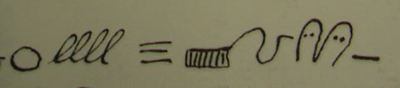
I have on several occasions encountered mentions of a pictograph style of sign
language writing used by native Americans for PST ([Farnell 1995]: 244--247,
[Graber 2018]), which seems to often be mixed with more logographic symbols as
well.---It is not clear to me how complete this system of writing is, but I
would be greatly amiss if I did not include it on this list.
Graber ([2018][Graber 2018]) describes the shape and meaning of some of these
symbols, as used in a letter in 1890, but, unfortunately, she does not compare
the symbols directly to the corresponding signs in PST.
> [...] A circle followed by four loops signifies four brothers. Three
> horizontal lines stand for the number three. A box with vertical lines,
> followed by a swooping downward and then upward line, means that someone has
> been buried in a grave. Together, the signs tell Cozad that he no longer had
> four brothers, but only three. One had recently died and been buried.
>
> <figure>
> 
> <figcaption>
> Symbols relating the death and burial of Cozad’s brother. Used by
> permission from Dickinson Research Center, National Cowboy & Western
> Heritage Museum.
> </figcaption>
> </figure>
>
> ([Graber 2018])
> <figure>
> 
> <figcaption>
> Figure 7.1. Graphic depictions of Plains Sign Talk by American Indians. Top
> part of illustration from [Tomkins 1926]:85. ([Farnell 1995]: 245)
> </figcaption>
> </figure>
> Some caution is indeed necessary when dealing with Tomkins' treatment of
> pictographs. While inscriptions on rock, birch bark, and hides were
> widespread in indigenous North America and served many communicative and
> mnemonic functions, Tomkins may well have invented these "pictographic
> stories" himself. I have not yet come across any other records of stories or
> messages written in the spiral form that Tomkins presents ([1926][Tomkins
> 1926]:89), and he may have taken this idea from Dakota winter counts (see
> [Mallery 1886] for examples). Most of the pictographic "building blocks" used
> by Tomkins can also be found in the more scholarly collections of Schoolcraft
> and Mallery, however (e.g., SKY as half circle in Schoolcraft
> [1851--1857][Schoolcraft 1851--1857], vol. 1, pp. 390, 407; RIVER in
> [Schoolcraft 1851--1857], vol. 2, plate 57; TRADE in [Mallery 1886]:220). A
> good example of a message written using pictographs of this kind and written
> by an Assiniboine person can be found in Denig [[1930][Denig 1961]] 1961:603.
>
> Further examples of pictographs representing the movement paths of signs are
> described in [Mallery 1886]:219--221 and [1893][Mallery 1893]:639--641, e.g.,
> PIPE, HUNGER, LITTLE CHIEF, DAKOTA, NOON. The only two exceptions to this I
> have encountered to date are (a) a seated human figure signifying "pipe" in
> which the Dakota artist drew a tiny human figure making the sign PIPE instead
> of drawing a pipe (see Batiste Goode's winter count in [Mallery 1886]:219);
> and (b) "Afraid of Him" a name sign in Red Cloud's census that shows the
> handshape and arm position from the sign AFRAID ([Mallery 1886]:639). It is
> interesting to note in passing that Dakota pictographs of persons who were
> prisoners are depicted without hands to denote helplessness ([Mallery
> 1886]:242).
>
> ([Farnell 1995]: 246--247)
References for the citations in the quote above:
<div class=hanging>
[Denig 1961]: #denig-1961
[#denig-1961] Denig, Edwin Thompson. (1961). *Five Indian tribes of the Upper
Missouri* (John C. Ewers, Ed.). University of Oklahoma Press. (Original work
published 1930; Also available from
https://readingroo.ms/4/9/5/5/49557/49557-h/49557-h.htm)
[Tomkins 1926]: #tomkins-1926
[#tomkins-1926] Tomkins, William. (1926). *Universal Indian sign language of
the Plains Indians of North America*. Published by author. (Reprinted 1969,
Dover Publications; Also available from
https://archive.org/details/bp_985073)
[Mallery 1886]: #mallery-1886
[#mallery-1886] Mallery, Garrick. (1886). *Pictographs of the North American
Indians*. *Bureau of American Ethnology Annual Report, 4*, 1--256.
Smithsonian Institution.
https://archive.org/details/PictographsOfTheNorthAmerican86Pages3256GarrickMallery
[Mallery 1893]: #mallery-1893
[#mallery-1893] Mallery, Garrick. (1893). *Picture Writing of the American
Indians.* *BAE Annual Report* 10. Washington, D.C.: Smithsonian Institution.
(Reprinted 1972. Dover Publications.
https://archive.org/details/picturewritingof0001mall)
[Schoolcraft 1851--1857]: #schoolcraft-1851--1857
[#schoolcraft-1851--1857] Schoolcraft, Henry Rowe. (1851--1857). (Ed.).
*Information respecting the history, condition and prospects of the Indian
tribes of the United States* (Vols. 1--6). Lippincott, Grambo and Co.
(Available from [archive.org](https://archive.org/search?query=schoolcraft+respecting+history+condition+lippincott&sort=date&and\[\]=year:\[1851+TO+1857\]).)
</div>
[Mimography]: #mimography
## [#mimography] 1825: Mimography
<details class="hanging summary"><summary>
**Year:** 1825
**Title:** Mimography (original French: Mimographie, Portugese: Mimografia)
**Latin:** ○ (no Latin characters)
**Language:** LSF
**Country:** France (Paris)
**Creator:** Bébian, Roch-Ambroise Auguste (hearing)
**Source:** [Bébian 1825], [Fischer 1995], [Renard 2004]: 8--47, 168
**Graphemes:** ~190 ([Cardoso 2023]: 66, [Mendes 2020]: 57)
</summary></details>
To my knowledge there is no English translation of the original Bébian
([1825][Bébian 1825]) article. Renate Fishers article provides historical
context and gives a few examples of how to write using Mimography ([Fischer
1995]), but I have yet to see an article explaining Mimography in its entirety.
<div class=note>**In other sources:** Supalla et al. ([2014][Supalla et al.
2014]: 5) mentions Mimography in a footnote (spelling it with an superfluous
*e*---"Mimeography"). Renard ([2004][Renard 2004]) repeatedly refers to it as
"mimographique" which, presumably, is a more modern French spelling.</div>
[Kinemics]: #kinemics
## [#kinemics] 1960: Kinemics
<details class="hanging summary"><summary>
**Year:** 1960 ([West 1960] published)
**Title:** Kinemics (West Notation)
**Latin:** ◑
**Language:** PST
**Country:** United States
**Creator:** West, La Mont, Jr. (hearing)
**Source:** [West 1960], [Bergeron 2006], [Farnell 1995], [Renard 2004]: 168
**Graphemes:** ?
</summary></details>
Not derived from Stokoe notation according to Renard ([2004][Renard 2004]:
168).
The Kiremics system used by West ([1960][West 1960]) is quite unique. Symbols
are borrowed from both the Latin alphabet and other, phonetic alphabets. There
is no correspondence between a fingerspelling and the symbols used---instead
West assigns symbols by analogy the consonant charts used for spoken languages
letting the place of articulation (labial, alveo-dental, prepalatal, palatal
etc.) stand in for hand placement, and when writing hand shapes, also which
fingers unfolded/salient.
For example, the symbol ‹k› is described as "hand extended, but relaxed, ulnar
edge (little finger or right edge) active and salient"---including not only
handshape, but also which part of the hand is active/salient in its use.
> The number of kinemes charted above ie 66: 18 hand shapes, 40 referents and 8
> directions. The number of different symbols utilized to notate these 66
> kinemes is 39: 34 basic alphabetic symbols and 5 diacritics. ([West 1960]:
> 20)
* https://en.wikipedia.org/wiki/La_Mont_West
[Stokoe Notation]: #stokoe
## [#stokoe] 1960: Stokoe Notation
<details class="hanging summary"><summary>
**Year:** 1960 ([Stokoe 1960] published)
**Title:** Stokoe Notation (also 'Stokoe system', French: 'notation Stokoe')
**Latin:** ◑
**Language:** ASL
**Country:** United States
**Creator:** Stokoe, William C. (hearing)
**Source:** [Stokoe 1960], [Renard 2004]: 59--64, 166, 168
**Graphemes:** 55 (https://scriptsource.org/entry/vwtyy3tjrf)
</summary></details>
<figure>

<figcaption>
Picture from [*Symbol Font for ASL*
webpage](https\://aslfont.github.io/Symbol-Font-For-ASL/ways-to-write.html#StokoeNotation)
</figcaption>
</figure>
> The fifty-five symbols used in Stokoe's original script are based on the
> shapes of Latin letters, punctuation, and numbers. The script has not been
> standardized, and has been adapted for use with various signed languages, so
> some consider it a family of related scripts, rather than a single script.
> Stokoe dubbed the three types of symbols tab ("tabula" or sign location), dez
> ("designator" or handshape & orientation), and sig ("signification" or motion
> & action). Symbols are written in strict tab-dez-sig: TD^S^ order.
>
> Stokoe Notation has been criticized for not distinguishing between sharp and
> soft manner of movement or between tenseness and laxness, nor representing
> uneven rate of signing or facial expression, all of which are salient
> elements of ASL. The script is also not equipped to handle ASL pronouns.
> (https://scriptsource.org/entry/vwtyy3tjrf)
> Stokoe Notation was first described in 1960 by William C. Stokoe. Stokoe was
> the first person to actually document that a sign language was a language in
> its own right. He later published a dictionary (1965) for American Sign
> Language (ASL) using this notation. In general, his original system used
> existing characters on typewriters that could be re-used, however they
> clearly have different semantic uses. Subsequently, Stokoe Notation has been
> taken and (greatly) expanded by several other sign languages including
> British Sign Language (BSL), Italian Sign Language (LIS) and Signed Swedish
> (SS). ([2012][Priest 2012]).
The "Signed Swedish" part above is incorrect. Swedish sign language
transcription have been in the employ of proper Swedish Sign Language since the
beginning, though the confusion might have arisen from the fact that the book
that first proposed the Swedish version ([Bergman 1977]) is titled "Signed
Swedish", even though the author is scathingly critical of the practice of
using the spoken language syntax for sign language.
* https://en.wikipedia.org/wiki/Stokoe_notation
[DASL Notation]: #dasl
## [#dasl] 1965: DASL Notation
<details class="hanging summary"><summary>
**Year:** 1965 ([Stokoe, Casterline & Croneberg 1965] published)
**Title:** DASL Notation (Dictionary of ASL Notation)
**Latin:** ◑
**Language:** ASL
**Country:** United States
**Creator:** Stokoe, William C. (hearing);
Casterline, Dorothy C. (deaf);
Croneberg, Carl G. (deaf)
**Source:** [Stokoe, Casterline & Croneberg 1965], [Renard 2004]: 168
**Graphemes:** ?
</summary></details>
FIXME: Renard classifies the Stokoe notation and DASL notation as two different
systems, however I think that's probably not true. I think DASL notation is a
minor development that should probably be described in the Stokoe notation
section, while this section should be removed. This section remains here until
that is verified, however.
[EWMN]: #ewmn
## [#ewmn] 1971: EWMN
<details class="hanging summary"><summary>
**Year:** 1971 ([Eshkol 1971] published)
**Title:** EWMN (Eshkol--Wachman Movement Notation)
**Latin:** ◑ (numbers, and text labels for rows, also many custom symbols)
**Language:** ISL
**Country:** United States
**Creator:** Eshkol, Noa (hearing?); Wachman, Avraham (hearing?)
**Source:** [Eshkol 1971] (?), [Cohen, Namir & Schlesinger 1977] (?), [Renard 2004]: 168
**Graphemes:** ?
</summary></details>
<figure class="ewmn2">
<style>.ewmn2 {
--gap: calc(var(--leading) * .5rem);
--small-height: 300px;
flex-flow: row wrap;
&, & > div {
display: flex;
gap: var(--gap);
justify-content: center;
}
& img {
margin: 0;
height: calc(var(--small-height) + var(--small-height) + var(--gap));
}
& div {
flex-flow: column;
& img { height: var(--small-height) }
}
}</style>
<div>
</div>
<figcaption style="width:100%">
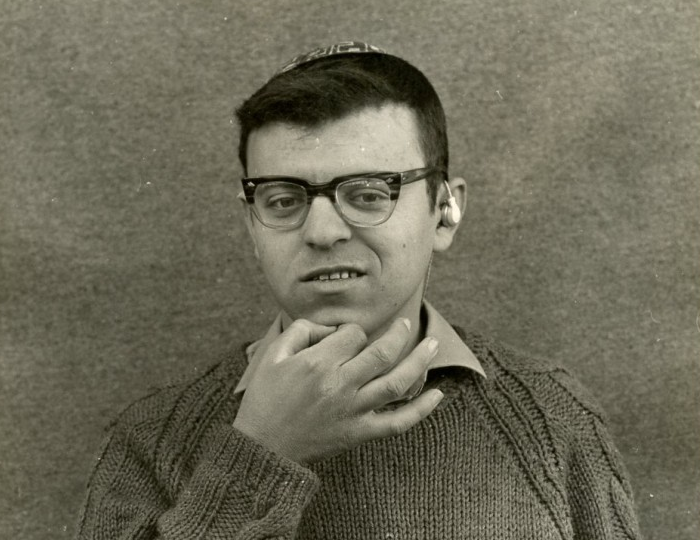
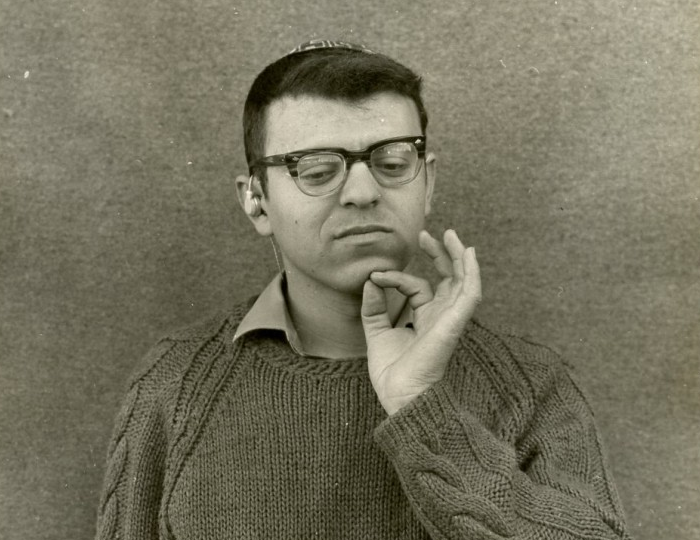
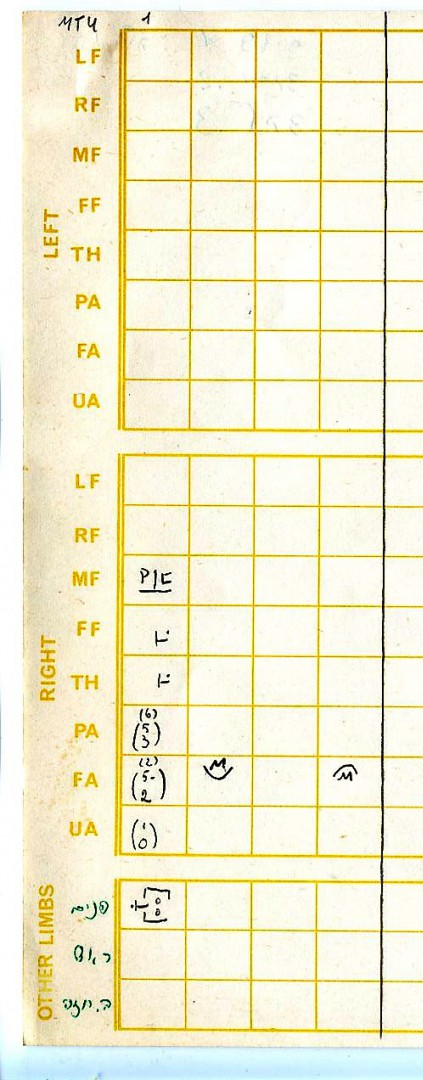
The sign "young" in ISL, written in Eshkol--Wachman Movement Notation.
<br>(Pictures from https://noaeshkol.org/gallery/hands)
</figcaption>
</figure>
<figure class=ewmn>
<style>.ewmn {
width: 100%;
text-align: center;
& img { display: inline; margin: 0 }
}</style>

<figcaption>
Row labels for sign language. ([Eshkol 1971]: 1)
<br>(Picture from https://noaeshkol.org/gallery/hands)
</figcaption>
</figure>
In 1971 Noa Eshkol published "The Hand Book" in which she extends the
Eshkol--Wachman Movement Notation, so that it can be used write the handshapes
needed for the transcription of Israeli sing language ([Eshkol 1971]). This
system would later be used in *A new dictionary of sign language* ([Cohen,
Namir & Schlesinger 1977]).
Eshkol--Wachman Movement Notation was originally published in 1958 by the dance
composer Noa Eshkol (נועה אשכול), in collaboration with the architect Avraham
Wachman (אברהם וכמן). They continued to work together to refine and develop the
system further for over twenty years.
The system consists of a table of rows (one for each joint one wish to
transcribe) and columns (indicating the progress of times). Symbols and joint
angles are written into this table in chronological order from left to right.
([Eshkol & Wachman 1958]).
The notation was invented to describe body movements, particularly for writing
dance scores. The system has been used in many other fields as well, including
dance, physical therapy, animal behavior and early autism diagnosis.
(https://scriptsource.org/scr/Qaah)
> [...], the system is highly complex and if care is not taken such wealth of
> detail could confuse rather than clarify. ([Brennan 2004]: 26)
* https://noaeshkol.org/about-eshkol-wachman-movement-notation
* https://noaeshkol.org/gallery/hands
* [http\://ewmncenter.com/133376/Movement-Notation-1-1-1](https://web.archive.org/web/20131030035325/http\://ewmncenter.com/133376/Movement-Notation-1-1-1) (archived October 2013)
[SignWriting]: #signwriting
## [#signwriting] 1974: SignWriting
<details class="hanging summary"><summary>
**Year:** 1974
**Title:** SignWriting (also Sutton SignWriting)
**Latin:** ○
**Language:** Any
**Country:** Denmark(?), United States
**Creator:** Sutton, Valerie (hearing)
**Source:** [Renard 2004]: 96--114, 166, 168
**Graphemes:** >670 ([Mendes 2020]: 75)
</summary></details>
<figure>

<figcaption>
Picture from [*Symbol Font for ASL*
webpage](https\://aslfont.github.io/Symbol-Font-For-ASL/ways-to-write.html#SignWriting)
</figcaption>
</figure>
Not derived from Stokoe notation according to Renard ([2004][Renard 2004]).
**On "year" above:** Renard gives the creation year as "1973".
<figure class=fixme>
<figcaption>FIXME: Verify this AI-generated summary</figcaption>
| Creator | Valerie Sutton (a hearing dancer and movement writing specialist), with collaboration from Adam Frost (a Deaf researcher)
| Country | Initiated at the request of researchers in Copenhagen, Denmark, but Valerie Sutton is American
| Language | Designed to precisely write any signed language. It is becoming a daily writing system for languages like ASL, German Sign Language, and Brazilian Sign Language. It can document all five parameters of sign languages using its specific alphabet, the International SignWriting Alphabet (ISWA 2010). It is a pictorial, bidimensional, and typically vertical writing system. It includes approximately 900 symbols
| Estimates for numbers of users today | In use in many countries (over 40) and was chosen for a preliminary ASL Wikipedia translation. It is considered the "most known and widespread" system and one of the "most promising systems" in Brazil. It is taught in specialized schools in various countries
</figure>
* https://en.wikipedia.org/wiki/SignWriting
* https://gebaerdenschrift.de
[Friedman--Mandel Notation]: #friedman-mandel
## [#friedman-mandel] 1976: Friedman--Mandel Notation
<details class="hanging summary"><summary>
**Year:** 1976
**Title:** Friedman--Mandel Notation (?)
**Latin:** ?
**Language:** ASL(?)
**Country:** United States
**Creator:** Friedman--Mandel(?)
**Source:** [Renard 2004]: 168
**Graphemes:** ?
**Parent:** [Stokoe notation] (according to [Renard 2004]: 168)
</summary></details>
<div class=note>I have only seen this notation in Renard ([2004][Renard 2004]),
and it's only found in a list of notation systems, without further
details.---Verify that it actually exists!</div>
[Bergman Notation]: #bergman
## [#bergman] 1977: Bergman Notation
<details class="hanging summary"><summary>
**Year:** 1977 ([Bergman 1977] published)
**Title:** Bergman Notation
**Latin:** ◑ (alphabetical symbols for handshapes, many novel symbols & diacritics)
**Language:** STS
**Country:** Sweden
**Creator:** Bergman, Brita (hearing)
**Source:** [Bergman 1977], [Hedberg 1989]: 62, [Wallin 1994], [Renard 2004]: 168
**Graphemes:** ~140 ([Zrajm 2017])
**Parent:** [Stokoe notation] (according to [Renard 2004]: 168)
</summary></details>
*Bergman notation* was first described in Bergman ([1977][Bergman 1977]), but
has later been significantly updated and revised. Hedberg added a symbols for
simplified circular movement and waving ([Hedberg 1989]: 62). Wallin added
several new, more detailed handshapes and symbols for motions with an abrupt
ending or start ([Wallin 1994]: 159--161). Finally the system was revised and
simplified for broader non-academic use when the official Swedish Sign Language
Lexicon was first published ([Hedberg 1997]). Bergman notation is still in use
by the online version of the dictionary ([Svenskt teckenspråkslexikon 2008]).
The last guide to its use is Bergman & Björkstrand ([2015][Bergman &
Björkstrand 2015]). There's also a Unicode font available online ([Zrajm
2017]).
The number of graphemes have varied over time, but font currently used by the
Swedish Sign Language Lexicon ([Svenskt teckenspråkslexikon 2008]) includes 40
locations symbols (including 5 diacritics), 40 handshapes, 12 attitude symbols,
41 motion symbols, 16 other symbols. Some of these symbols were requested by
the lexicon (when I designed the font) but is not (yet?) in use, such as symbol
for 'neutral position' (`U+10c9b3`), or Hedberg's more intuitive circular
motion glyphs (`U+10c9ae`, `U+10c9af` and `U+10c9b0`), or the 'bounce' motion
symbol (`U+10c9b6`). Wallin ([1994][Wallin 1994]) use a handful of handshape
symbols that are not included in the font, and the font also include an
experimental set of 'finger phonetics' symbols (for describing arbitrary
handshapes) that, to my knowledge, have never been used outside of my own
writing. ([Zrajm 2017]).
Bergman notation borrows from Stokoe notation, but deviates is many ways, among
other things it uses Swedish fingerspelling alphabet for the handshape symbols,
and features a more detailed attitude description ([Bergman 1977]: 90--92).
[Corazza Notation]: #corazza
## [#corazza] 1980: Corazza Notation
<details class="hanging summary"><summary>
**Year:** 1980
**Title:** Corazza Notation
**Latin:** ◕ (mostly alphabetical, some funny diacritics)
**Language:** LIS
**Country:** Italy
**Creator:** Corazza, Serena (deaf)
**Source:** [Renard 2004]: 168, [Miller 2001]
**Graphemes:** ?
**Parent:** [Stokoe notation] (according to [Renard 2004]: 168)
</summary></details>
Derived from the Berkeley group (in turned derived from DASL), together with
[Radutzky notation] according to Miller ([2001][Miller 2001]).
...I'm not 100% sure this counts as a complete notation system, as Corazza
([1990][Corazza 1990]) only give examples for classifiers.
> I use the notational system adopted for LIS in Corazza et al.
> ([1985][Corazza 1985]) and Volterra ([1986][Volterra 1987]). ([Corazza 1990])
[IVT Notation]: #ivt
## [#ivt] 1980: IVT Notation
<details class="hanging summary"><summary>
**Year:** 1980
**Title:** IVT Notation
**Latin:** ?
**Language:** LSF
**Country:** France
**Creator:** International Visual Théâtre
**Source:** [Renard 2004]: 71--77, 168
**Graphemes:** ?
</summary></details>
Not derived from Stokoe notation according to Renard ([2004][Renard 2004]).
<figure class=fixme>
<figcaption>FIXME: Verify this AI-generated summary</figcaption>
| Creator | A group of French Deaf individuals
| Language | Not explicitly stated, but implied for French Sign Language (LSF) due to its origin. It is described as a "notation"
| Estimates for numbers of users today | Appears to be a by-product of studies for their dictionaries. It is "quickly presented" during workshops but is not systematically taught or published in their dictionaries
</figure>
[SignLettering]: #signlettering
## [#signlettering] 1980?: SignLettering
<details class="hanging summary"><summary>
**Year:** 1980?
**Title:** SignLettering
**Latin:** ● (numerals, Latin characters & diacritics)
**Language:** any
**Country:** United States (Germany?)
**Creator:** Teuber, Hartmut (deaf)
**Source:** ([Quora](#signlettering-quora))
**Graphemes:** ?
</summary></details>
Teuber describes SignLettering ([across several postings on
Quora](#signlettering-quora), below) as a phonetic system which uses Roman
letters (in upper and lower case), numerals and diacritics. He furthers gives
the impression (though this is less certain) that the system can be used for
any language, but that by adapting it to a specific language the spelling for
that language can be simplified.
<div></div>
SignLettering is referenced in multiple places on the internet (though not so
much in the English-speaking part), most prominently on German Wikipedia:
> Ferner erschien in der Tradition des Stokoe-Systems an der Universität
> Hamburg das wissenschaftlich orientierte HamNoSys (Hamburger
> Notations-System)^[11]^ für die Deutsche Gebärdensprache und ein
> phonetisch/phonemisches System <mark>SignLettering</mark>^[12]^ von dem
> Pädagogen Hartmut Teuber (USA). ([German Wikipedia:
> "Gebärdenschrift"](https://de.wikipedia.org/wiki/Gebärdenschrift), accessed
> 29 September 2025)
In ChatGPT's translation:
> Furthermore, in the tradition of the Stokoe system, the scientifically
> oriented HamNoSys (Hamburg Notation System)^[11]^ for German Sign Language
> and a phonetic/phonemic system called <mark>SignLettering</mark>^[12]^ by the
> educator Hartmut Teuber (USA) were developed at the University of Hamburg.
The above source references correspond to:
<div class=hanging>
^[11]^ [Uni Hamburg,
HamNoSys](https://web.archive.org/web/20170104033928/http\://www.sign-lang.uni-hamburg.de/dgs-korpus/index.php/hamnosys.html)
(archived January 4, 2017)
^[12]^ Teuber et al. ([1980][Teuber et al. 1980])---Incorrectly referenced, as
source does not mention SignLettering.
</div>
However, the source given by Wikipedia ([Teuber et al. 1980]), does not mention
SignLettering at all! (Teuber is one of the article authors, but the article is
all about how to encode Stokoe notation for database use.)
<div id="signlettering-quora">
The creator of SignLettering, Hartmut Teuber, has given us a few tidbits about
his system in answers he has given on Quora (https://quora.com):
> I developed one [writing system] that is called SignLettering, using letters
> and numerals to denote the phonetic components in signs, which can be
> simplfied [sic] to become a working writing system after determining the
> phonemics of a particular sign language. (Teuber 2022, [Quora: "How do you
> say 'read' in sign
> language?"](https://quora.com/How-do-you-say-read-in-sign-language))
> I have developed a phonetic/phonemic writing system for any signed langguage
> [sic]. I called it SignLettering, because I use the Roman letters in lower
> and upper cases. It is an "Escalatorsystem" whereby several phonetic codes to
> single phonemes crystallize. I haven't advertised or tried to market it aside
> of presenting it at conferences. (Teuber 2023, [Quora: "Is there a standard
> writing system for sign
> language?"](https://quora.com/Is-there-a-standard-writing-system-for-sign-language))
> Myself have created a different system, using letters, numerals, and
> diacritics, called SignLettering. (Teuber 2024, [Quora: "What is the process
> for transcribing sign language into written words for a deaf
> person?"](https://quora.com/What-is-the-process-for-transcribing-sign-language-into-written-words-for-a-deaf-person))
Sadly, Quora sucks as a source. The dates given above are very approximate (as
the site only says '2 years ago' etc., with no further granularity to be found)
and to access some of the pages directly a Quora+ subscription is needed. :(
</div>
[Farnell Labanotation]: #farnell-labanotation
## [#farnell-labanotation] 1984: Farnell Labanotation
<details class="hanging summary"><summary>
**Year:** 1984 ([Farnell 1984a] published)
**Title:** Farnell Labanotation
**Latin:** ○ (non-alphabetical)
**Language:** PST, ASL
**Country:** United States
**Creator:** Farnell, Brenda (hearing)
**Source:** [Farnell 1984a] (?), [Farnell 1995], [Renard 2004]: 168
**Graphemes:** ?
</summary></details>
<figure class=farnell>
<style>.farnell {
display: flex;
flex-flow: row wrap;
justify-content: space-between;
gap: 8px;
& img { display: inline; margin: 4px; vertical-align: middle }
}</style>
<div></div>
<div></div>
<div></div>
<div></div>
<figcaption style="width:100%">
ASL signs written in Labanotation ([Farnell 1995]: 252).
</figcaption>
</figure>
Farnell built on the already existing [Labanotation][Wikipedia:
"Labanotation"], adapting it for sign language transcription in her master's
thesis ([Farnell 1984a], [Farnell 1984b]). She has continued using it do
transcribe both ASL and PST ([Farnell 1985], [Farnell 1995]).
The original Labanotation system was created by Rudolf von Laban in the 1920s
for writing dance movements ([von Laban 1928--1931]). Drid Williams later used
the system in her anthropological studies of movement and dance (FIXME:
reference), and she introduced the system to her student, Brenda Farnell.
<div>
**On "year" above:** The year given above indicates when it became possible to
use Labanotation for writing sign languages, not the year it was originally
created.
Renard ([2004][Renard 2004]) also lists a notation called *Laban--Benesh
Labanotation* (1969) -- But I think this notation (like the original
Labanotation) is meant for choreography, not sign language transcription.
(FIXME: verify this)
</div>
[Wikipedia: "Labanotation"]: https://en.wikipedia.org/wiki/Labanotation
[HamNoSys]: #hamnosys
## [#hamnosys] 1984?: HamNoSys
<details class="hanging summary"><summary>
**Year:** 1984?
**Title:** HamNoSys (Hamburg Notation System)
**Latin:** ◔
**Language:** Any
**Country:** Germany
**Creator:** Prillwitz; Vollhaber
**Source:** [Prillwitz et al. 1987], [Prillwitz et al. 1989], [Renard 2004]: 81--95, 168
**Graphemes:** 210
**Parent:** [Stokoe notation] (according to [Renard 2004]: 168)
</summary></details>
<figure>

<figcaption>
Picture from [*Symbol Font for ASL*
webpage](https\://aslfont.github.io/Symbol-Font-For-ASL/ways-to-write.html#HamNoSys)
</figcaption>
</figure>
**On "year" above:**
[Wikipedia](https://en.wikipedia.org/wiki/Hamburg_Notation_System) says that
HamNoSys was created in 1984.
> HamNoSys (first version defined in 1984, first published version Prillwitz et
> al., 1987) [...] ([Hanke 2004])
> Hamnosys (Hamburg Notation System) was invented at the University of Hamburg
> (Germany) by Prillwitz, Vollhaber, and their collaborators in 1989^(1)^.
>
> <div></div>
>
> ^(1)^: http://www.sign-lang.uni-hamburg.de/dgs-korpus/index.php/hamnosys-97.html
>
> ([Renard 2004]: 81)
Below, both citations ([Miller 2001]) are slightly wrong: "Prillwitz &
Vollhaber 1989" refers to a whole book, but that volume in its entirety is not
included in Miller's reference section, which instead includes the relevant
article, Prillwitz & Zienert ([1990][Prillwitz & Zienert 1990]), found in the
same book. Also the publication year for "Prillwitz et al. 1990" should have
been listed as [1989][Prillwitz et al. 1989].
> **2.2.2 HamNoSys ([Prillwitz & Vollhaber 1989][Prillwitz & Zienert 1990];
> [Prillwitz et al. 1990][Prillwitz et al. 1989])**
>
> <div></div>
>
> This system, designed with the aim of applicability to the largest number of
> sign languages possible, attempts maximum iconicity in its inventory of
> symbols, including handshapes. It provides for detailed notation of point of
> contact on the non-dominant hand as well as for the notation of spatial
> locations. Provision is made for notation of nonmanuals. The system is
> available as a complete software package for the Macintosh operating system
> and a computer font for Windows. ([Miller 2001]: 16)
<figure class=fixme>
<figcaption>FIXME: Verify this AI-generated summary</figcaption>
| Year |Development began in 1985, with the first version published in 1984 and further details in 1987
| Creator | A group of researchers at the University of Hamburg (including Prillwitz, Leven, Zienert, Hanke, and Henning)
| Country | Germany (University of Hamburg)
| Language | Designed to precisely write any signed language, including non-manual features. It employs iconic representations for handshapes and other parameters. It is a linear system, read left-to-right, and uses subscripts, superscripts, and diacritics. It is adaptable for various sign languages. It contains 210 characters
| Estimates for numbers of users today | It is popular for academic purposes and is one of the most widely used notation systems by researchers. It is considered the "most developed" system derived from Stokoe
</figure>
* https://en.wikipedia.org/wiki/Hamburg_Notation_System
* https://www.scriptsource.org/scr/Qabn
* [http\://www.sign-lang.uni-hamburg.de/dgs-korpus/index.php/hamnosys.html](https://web.archive.org/web/20120731125038/https\://www.sign-lang.uni-hamburg.de/dgs-korpus/index.php/hamnosys-97.html) (archived July 2012)
[Kyle & Woll Notation]: #kyle+woll
## [#kyle+woll] 1985: Kyle & Woll Notation
<details class="hanging summary"><summary>
**Year:** 1985
**Title:** Kyle & Woll Notation
**Latin:** ?
**Language:** BSL(?)
**Country:** Great Britain
**Creator:** Kyle, James G.; Woll, Bencie
**Source:** [Kyle & Woll 1985], [Miller 2006], [Renard 2004]: 168
**Graphemes:** ?
**Parent:** [Stokoe notation] (according to [Renard 2004]: 168)
</summary></details>
[SignFont]: #signfont
## [#signfont] 1987: SignFont
<details class="hanging summary"><summary>
**Year:** 1987
**Title:** SignFont
**Latin:** ◔
**Language:** ASL
**Country:** United States
**Creator:** Newkirk, Don E. (hearing)
**Source:** [McIntire et al. 1987], [Renard 2004]: 168
**Graphemes:** ?
</summary></details>
<figure>

<figcaption>
Picture from [*Symbol Font for ASL*
webpage](https\://aslfont.github.io/Symbol-Font-For-ASL/ways-to-write.html#SignFont)
</figcaption>
</figure>
Not derived from Stokoe notation according to Renard ([2004][Renard 2004]).
SignFont creation date is given as 1987 by ASL Font (2021), Cardoso (2023) &
Mendes (2020), and 1988 by Renard (2004).
The handshapes, syntactic nonmanual markers, and adverbial nonmanual markers of
SignFont are described in McIntire et al. ([1987][McIntire et al. 1987]:
211--213), this however this article does not seem to present a complete
system, and only lists the symbols without giving full examples of their use.
* [http\://members.home.net/dnewkirk/signfont/orthog.htm](https://web.archive.org/web/20010222184041/http\://members.home.net/dnewkirk/signfont/orthog.htm)
(earliest archived February 2001)
* https://de.wikipedia.org/wiki/SignFont
* https://scriptsource.org/scr/Qaao
[Edinburgh--Durham Notation]: #edinburgh-durham
## [#edinburgh-durham] 1988: Edinburgh--Durham Notation
<details class="hanging summary"><summary>
**Year:** 1988
**Title:** Edinburgh--Durham Notation (?)
**Latin:** ?
**Language:** BSL(?)
**Country:** Great Britain
**Creator:** ?
**Source:** [Renard 2004]: 168, [Miller 2001]
**Graphemes:** ?
**Parent:** [Stokoe notation] (according to [Renard 2004]: 168)
</summary></details>
Renard ([2004][Renard 2004]) refers to this as "Edinburgh--Durham", while
Miller ([2001][Miller 2001]) refers to it as "Edinburgh/Durham (BSL Dictionary)
1993", both without giving any further explanation or source reference.
[Radutzky Notation]: #radutzky
## [#radutzky] 1988: Radutzky Notation
<details class="hanging summary"><summary>
**Year:** 1988
**Title:** Radutzky Notation (?)
**Latin:** ?
**Language:** LIS
**Country:** Italy
**Creator:** Radutzky, Elena (hearing)
**Source:** [Radutzky 1988], [Radutzky 1989], [Renard 2004]: 168, [Miller 2001], [Radutzky 2024]
**Graphemes:** ?
**Parent:** [Stokoe notation] (according to [Renard 2004]: 168)
</summary></details>
* FIXME: Which Radutzky source is correct, if any? Investigate!
Derived from the Berkeley group (in turned derived from DASL), together with
[Corazza notation] according to Miller ([2001][Miller 2001]).
Renard ([2004][Renard 2004]) misspells the name as "Raclutzky".
**On "Creator" above:** Radutzky changed her name to Elena (from Ellen J.),
with her early work being published under the earlier name. ([Radutzky 2024]:
421--422)
[Liddell & Johnson Notation]: #liddell+johnson
## [#liddell+johnson] 1989: Liddell & Johnson Notation
<details class="hanging summary"><summary>
**Year:** 1989
**Title:** Liddell & Johnson Notation
**Latin:** ?
**Language:** ?
**Country:** United States
**Creator:** Liddell; Johnson
**Source:** [Renard 2004]: 168
**Graphemes:** ?
</summary></details>
Not derived from Stokoe notation according to Renard ([2004][Renard 2004]), who
also misspells Liddell's name as "Liddel".
[D'Sign]: #dsign
## [#dsign] 1990: D'Sign
<details class="hanging summary"><summary>
**Year:** 1990
**Title:** D'Sign
**Latin:** ◔
**Language:** LSF
**Country:** France
**Creator:** Jouison, Paul (hearing)
**Source:** [Jouison 1990], [Renard 2004]: 78--80, 166, 168
**Graphemes:** ?
</summary></details>
> In 1983 and 1990, Paul Jouison published "D'Sign" as a notation system for
> French Sign Language.
Not derived from Stokoe notation according to Renard ([2004][Renard 2004]).
[Papaspyrou Notation]: #papaspyrou
## [#papaspyrou] 1990: Papaspyrou Notation
<details class="hanging summary"><summary>
**Year:** 1990
**Title:** Papaspyrou Notation
**Latin:** ?
**Language:** any(?)
**Country:** Germany
**Creator:** Papaspyrou, Chrissostomos
**Source:** [Renard 2004]: 168
**Graphemes:** ?
**Parent:** [Stokoe notation] (according to [Renard 2004]: 168)
</summary></details>
[Schermer Notation]: #schermer
## [#schermer] 1990: Schermer Notation
<details class="hanging summary"><summary>
**Year:** 1990
**Title:** Schermer Notation (?)
**Latin:** ?
**Language:** NGT
**Country:** Netherlands
**Creator:** Schermer
**Source:** [Renard 2004]: 168, [Miller 2001]
**Graphemes:** ?
**Parent:** [Stokoe notation] (according to [Renard 2004]: 168)
</summary></details>
Derived from the Berkeley group (in turned derived from DASL) according to
Miller ([2001][Miller 2001]).
<div class=hanging>
Schermer, T. (1990). *In search of a language: Influences from spoken Dutch on
Sign Language of the Netherlands* [Doctoral dissertation]. University of
Amsterdam.
</div>
[Johnston Notation]: #johnston
## [#johnston] 1991: Johnston Notation
<details class="hanging summary"><summary>
**Year:** 1991
**Title:** Johnston Notation
**Latin:** ?
**Language:** Auslan(?)
**Country:** Australia
**Creator:** Johnston
**Source:** [Renard 2004]: 168
**Graphemes:** ?
**Parent:** [Stokoe notation] (according to [Renard 2004]: 168)
</summary></details>
[Zaytseva notation]: #zaytseva
## [#zaytseva] 1991?: Zaytseva notation
<details class="hanging summary"><summary>
**Year:** 1991?
**Title:** Zaytseva notation
**Latin:** ◕ (Cyrillic and Latin with arrows and some quirky symbols)
**Language:** RSL
**Country:** Russia
**Creator:** Zaytseva (hearing)
**Source:** [Zaytseva 2000]
**Graphemes:** 19 (explicitly mentioned, unknown additional number implied)
</summary></details>
<figure>

<figcaption>
Picture from [*Шрифт для записи РЖЯ* \[Font for writing RSL\] webpage](https://ajnoeo.github.io/rslfont/RSL_font/ways-to-write.html#Zaytseva)
</figcaption>
</figure>
Zaytseva ([2000][Zaytseva 2000]) presents a fragment of a potential notation
system for RSL. It serves to illustrate the components that a sign consists of.
The system is bilinear, using one line per hand, and describes handshape,
localization and movement. This is not a complete notation system and Zaytseva
explicitly notes this in the text:
> Let us emphasize that the author is far from believing the notation system
> she proposes to be completely devoped, finalized. A lot of work is needed to
> rigorously check if all the signs "fit" the notation. Maybe the picked
> parameters are not enough? Then wouldn't it happen that two signs have the
> same formula? ([Zaytseva 2000], transl. by Ajno/Artiom Boyko)
* [RSL Font, Ways to write](https://ajnoeo.github.io/rslfont/RSL_font/ways-to-write.html#Zaytseva)
[ASL-phabet]: #asl-phabet
## [#asl-phabet] 1992?: ASL-phabet
<details class="hanging summary"><summary>
**Year:** 1992?
**Title:** ASL-phabet
**Latin:** ◔ (no Latin characters)
**Language:** ASL
**Country:** United States
**Creator:** Supalla, Samuel (deaf)
**Source:** [Supalla et al. 2014], [ASL Font 2021], [Cardoso 2023]: 89--80, [Mendes 2020]: 39, Figura 18
**Graphemes:** 32
**Parent:** [SignFont]
**Use:** Children's education
</summary></details>
Supalla created ASL-phabet in order to teach deaf kids the alphabetic principle
as a step on the way to teaching of English writing and spelling. ASL-phabet
consists of only 32 graphemes: 22 handshapes, 5 locations, and 5 movements
([Supalla et al. 2014]).
<figure>

</figure>
> In the 1990's, Deaf linguist Samuel Supalla started working on a simplified
> system for writing ASL. He based it off of a system called SignFont that had
> been developed at the Salk Institute in California. ([ASL Font 2021])
* https://www.glossinstitute.com/video/asl-phabet-signing-out/
* https://en.wikipedia.org/wiki/ASL-phabet
* [http\://www.asl-phabet.com](https://web.archive.org/web/20180830033527/http\://www.asl-phabet.com)
(archived August 2018, requires Flash)
[ASCII-Stokoe Notation]: #ascii-stokoe
## [#ascii-stokoe] 1993: ASCII-Stokoe Notation
<details class="hanging summary"><summary>
**Year:** 1993 ([Mandel 1993] published)
**Title:** ASCII-Stokoe Notation
**Latin:** ● (uses only ASCII characters)
**Language:** ASL
**Country:** United States
**Creator:** Mandel, Mark Alan (hearing)
**Source:** [Mandel 1993], [Renard 2004]: 166, [Miller 2001]
**Graphemes:** ?
</summary></details>
* [http\://www.world.std.com/~MAM/ASCII-Stokoe.html](https://web.archive.org/web/20041026052838/http\://www.world.std.com/~MAM/ASCII-Stokoe.html)
(archived October 2004)
* [https\://theworld.com/~mam/ASCII-Stokoe.txt](https://web.archive.org/web/20030523230152/http\://theworld.com/~mam/ASCII-Stokoe.txt)
(archived May 2003)
[SBM Notation]: #sbm
## [#sbm] 1994: SBM Notation
<details class="hanging summary"><summary>
**Year:** 1994
**Title:** SBM Notation (Boyer-Haouam Signography; Signographie Boyer-Haouam)
**Latin:** ?
**Language:** LSF
**Country:** France
**Creator:** ?
**Source:** [Renard 2004]: 115--129, 166, 168
**Graphemes:** ?
</summary></details>
Not derived from Stokoe notation according to Renard ([2004][Renard 2004]).
<figure class=fixme>
<figcaption>FIXME: Verify this AI-generated summary</figcaption>
| Creator | Philippe Boyer & Nadia Haouam (Deaf teachers) |
| Year |1994 (when Haouam was trained and the method developed). Boyer's research on the system started between 1990--1995
| Country | France (INJS de Paris)
| Language | Developed for French Sign Language (LSF). It uses simple geometric figures for facial expressions and draws some inspiration from Chinese ideograms for hand configurations. It notes facial expressions and gaze orientation. It aims to be fluid and fast like written French. It is claimed it can write "any sign of any country"
| Estimates for numbers of users today | Described as the "only method of writing signs used in teaching in France" in specialised schools (e.g., INJS de Paris)
</figure>
[FBL Notation]: #fbl
## [#fbl] 1995?: FBL Notation
<details class="hanging summary"><summary>
**Year:** 1995?
**Title:** FBL Notation (Ferreira-Brito-Langevin Notation, Notação de Ferreira-Brito-Langevin)
**Latin:** ●?
**Language:** Libras
**Country:** France, Brazil
**Creator:** Ferreira Brito, Lucinda (hearing); Langevin, Rémi (hearing)
**Source:** ?
**Graphemes:** ?
</summary></details>
<figure class=fixme>
<figcaption>FIXME: Verify this AI-generated summary</figcaption>
| Use | Developed for a dictionary |
| Script | Latin symbols only |
</figure>
[Nève Notation]: #neve
## [#neve] 1996: Nève Notation
<details class="hanging summary"><summary>
**Year:** 1996
**Title:** Nève Notation (or *Gesteme Notation,* *Notation des Gestèmes*)
**Latin:** ◕
**Language:** LSFB
**Country:** Belgium
**Creator:** Nève, François-Xavier (hearing)
**Source:** [Renard 2004]: 65--70, 166, 168
**Graphemes:** ?
</summary></details>
Not derived from Stokoe notation according to Renard ([2004][Renard 2004]).
[ASL Orthography]: #asl-orthography
## [#asl-orthography] 1997: ASL Orthography
<details class="hanging summary"><summary>
**Year:** 1997
**Title:** ASL Orthography
**Latin:** ● (uses only ASCII characters)
**Language:** ASL
**Country:** United States
**Creator:** Low, Travis (hearing)
**Source:** [Low 1997], [ASL Font 2013], [Cardoso 2023], [Mendes 2020]
**Graphemes:** ~45
**Parent:** ?
</summary></details>
<figure>

<figcaption>
Picture from [*Symbol Font for ASL*
webpage](https\://aslfont.github.io/Symbol-Font-For-ASL/ways-to-write.html#ASLOrthography)
</figcaption>
</figure>
Low, a hearing student of ASL, created ASL Orthography for everyday language
use
([http\://www.dawnstar.org/travis/deaf](https://web.archive.org/web/20170430184314/http\://www.dawnstar.org/travis/deaf),
latest archived April 2017). Aspect is not well represented in the system, and
facial features/adverbs are not included at all
([http\://www.dawnstar.org/travis/deaf/asl](https://web.archive.org/web/20161023065658/http\://www.dawnstar.org/travis/deaf/asl),
latest archived October 2016).
<div class=hanging>
Achenbach, Philipp; Göksu, Yasmin; Kullmann, Timo; Tregel, Thomas & Göbel,
Stefan. (2021). "Towards Handshape Identification for Automatic Gesture
Recognition Using Sign Notation Systems". *8th European Conference on Social
Media, ECSM 2021,* 307--315(?). DOI 10.34190/ESM.21.004
ISBN 978-1-914587-00-9
</div>
[AusWrite]: #auswrite
## [#auswrite] 1997: AusWrite
<details class="hanging summary"><summary>
**Year:** 1997
**Title:** AusWrite (?)
**Latin:** ?
**Language:** Auslan
**Country:** Australia(?)
**Creator:** David Rose
**Source:** [Bergermann 2001]?, [Stiedl 2011]
**Graphemes:** ?
</summary></details>
<div class=note>Not to be confused with [AusWrit]. So far, I have not been able
get hold of the text of the primary sources for this system, so this
information is incomplete.</div>
> 1983 bzw. 1990 veröffentlichte Paul Jouison das „D'Sign" als Notationssystem
> für die französische Gebärdensprache. David Rose zog 1997 mit „AusWrite"
> (Auslan Writing System) für die australische Gebärdensprache nach. ([German
> Wikipedia: "Geschichte der
> Gebärdensprachen"](https://de.wikipedia.org/wiki/Geschichte_der_Gebärdensprachen),
> accessed 29 September 2025)
In ChatGPT's translation:
> In 1983 and 1990, Paul Jouison published D'Sign as a notation system for
> French Sign Language. In 1997, David Rose followed with AusWrite (Auslan
> Writing System) for Australian Sign Language.
Stiedl also mentions the system:
> As a French example, the unfinished project "D'Sign" by Paul Jouison (cf.
> Konrad 1992 / [Bergermann 2001]) may be mentioned here; as an Australian
> example, the project "AusWrite Auslan Writing System" by David Rose (cf.
> [Bergermann 2001]); and as an American example, "SignFont" by Newkirk et al.
> (cf. ibid), none of which will be discussed in greater detail in the context
> of this work. ([Stiedl 2011]: 90, translated with ChatGPT)
[ELiS]: #elis
## [#elis] 1997: ELiS
<details class="hanging summary"><summary>
**Year:** 1997 ([Barros 1997] published)
**Title:** ELiS (Escrita das Línguas de Sinais)
**Latin:** ◔ (no Latin characters)
**Language:** Libras/any
**Country:** Brazil
**Creator:** Barros, Mariângela Estelita (hearing)
**Source:** [Barros 1997], [Barros 2006], [Barros 2008], [Barros 2016], [Cardoso 2023], [Mendes 2020]
**Graphemes:** 90
</summary></details>
**On "year" above:** It should be either 1998 or 1997. Barros ([2006][Barros
2006]) and Barros ([2008][Barros 2008]) give the year as "1997", while Barros
([2016][Barros 2016]), Portugese Wikipedia ("[Portugese Wikipedia: Mariângela
Estelita Barros]") and Google Scholar give it as "1998".---I have not been able
to obtain the dissertation, so consider the exact year unknown.
[Portugese Wikipedia: Mariângela Estelita Barros]: https://pt.wikipedia.org/wiki/Mariângela_Estelita_Barros
<figure>
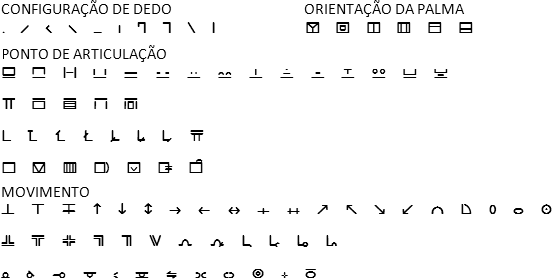
<figcaption>
Illustration from Portugese Wikipedia "[Escrita das línguas de
sinais](https://pt.wikipedia.org/wiki/Escrita_das_línguas_de_sinais)".
</figcaption>
</figure>
<div>
On the name "ELiS":
> ELiS is a writing system for LS [Sign Languages], with an alphabetic and
> linear basis. This system was created during my master's research in 1997,
> and since then it has been continuously refined based on suggestions from
> both deaf and hearing colleagues, as well as my own linguistic reflections.
> In fact, its name has evolved along with its theoretical development.
>
> It was originally called "AlfaSig" -- "Alfa" from "alphabetical" and "Sig"
> from the Latin "signalis". However, upon realizing the close association of
> "alfa," or "alphabetical," with a representation of sounds, I discarded the
> name. It was then called "QuiroSig," as the system represents the "quiremas"
> [chiremes] of signs, according to the terminology created by Stokoe. During
> the pilot study, however, the teacher of the class in which I served as a
> researcher noticed that the name lacked a reference to "writing" and referred
> only to "signs." For a period, the system was called ScripSig. It was later
> renamed again and is now simply and definitively presented as ELiS, an
> acronym for Escrita das Línguas de Sinais [writing of sign languages]. The
> structure of ELiS that I present here is from 2007. ([Barros 2008]: 25,
> translated using ChatGPT)
</div>
There is also a book about ELiS:
<div class=hanging>
[Barros 2015]: #barros-2015
[#barros-2015] Barros, Mariângela Estelita. (2015). *ELiS: Sistema Brasileiro
de Escrita das Línguas de Sinais* [ELiS: Brazilian Writing System for Sign
Languages]. Penso Editora. ISBN 978-8584290512
https://books.google.com?id=mVsbCgAAQBAJ
</div>
* https://pt.wikipedia.org/wiki/Escrita_das_línguas_de_sinais
[SMYLE]: #smyle
## [#smyle] 1997: SMYLE
<details class="hanging summary"><summary>
**Year:** 1997
**Title:** SMYLE (Signographie Manuscrite YaelLE)
**Latin:** ?
**Language:** LSF/any
**Country:** France
**Creator:** Pierrat-Frappé, Maryline (hearing)
**Source:** [Renard 2004]: 130--141, 166, 168
**Graphemes:** ?
</summary></details>
Not derived from Stokoe notation according to Renard ([2004][Renard 2004]).
* [http\://signographie.fr](https://web.archive.org/web/20181226120527/http\://signographie.fr/)
(archived December 2018, requires Flash)
[CSLDS notation]: #cslds-notation
## [#cslds-notation] 1998?: CSLDS notation
<details class="hanging summary"><summary>
**Year:** 1998?
**Title:** CSLDS notation
**Latin:** ◑
**Language:** HKSL(?)
**Country:** Hong Kong
**Creator:** ?
**Source:** https://www.cslds.org/v4/resources.php?id=1
**Graphemes:** ?
**Parent:** [Stokoe notation] (?)
</summary></details>
<div class=note>This a notation was recently brought to my attention (15
November 2025) by the awesome people at the *Signed Conlangs* Discord server.
This entry is mostly a placeholder until I can put something better here.</div>
<figure class=i9ms819>
<style>.i9ms819 { img { margin: 0 } td:first-child { white-space: nowrap } }</style>
| Font Name | Sample | Year |
|--------------------------------------------|----------------------------------------------------|-------|
| [`handshape.ttf`](pic/cslds-handshape.ttf) |  | 2002? |
| [`handkey.ttf`](pic/cslds-handkey.ttf) |  | 2002 |
| [`location.ttf`](pic/cslds-location.ttf) |  | 1998 |
| [`movement.ttf`](pic/cslds-movement.ttf) |  | 1998 |
<figcaption>
Fonts by *The Centre for Sign Linguistics and Deaf Studies* at The Chinese
University of Hong Kong (https://www.cslds.org/v4/resources.php?id=1).
</figcaption>
</figure>
Table above lists include the metadata copyright year for each of the font.
The font `handshape.tty` does not list a copyright year, but is *named*
'handshape2002-Regular' in the metadata, and thus I've used '2002' below.---Of
the fonts, this is clearly the least interesting of the four, since it is just
pictures of hands, and not really part any notation.
[Dimskis Notation]: #dimskis
## [#dimskis] 1998?: Dimskis Notation
<details class="hanging summary"><summary>
**Year:** 1998?
**Title:** Dimskis Notation
**Latin:** ◔ (two Cyrillic letters, otherwise custom symbols)
**Language:** RSL (Belarusian SL, usually considered a dialect of RSL)
**Country:** Belarus, Russia
**Creator:** Dimskis, Lidiya Sergeevna (hearing)
**Source:** [Dimskis 2002]
**Graphemes:** >260 (260 listed in Dimskis 1998; with 100 basic symbols +
combinations and modifications, theoretically infinite number
possible)
</summary></details>
<figure>

<figcaption>
Picture from [*Шрифт для записи РЖЯ* \[Font for writing RSL\]
webpage](https://ajnoeo.github.io/rslfont/RSL_font/ways-to-write.html#Dimskis)
</figcaption>
</figure>
This system is used in [Dimskis 2002], a textbook which teaches the basics of
RSL to hearing students. The book references Stokoe but the system used in the
book is not based on Stokoe notation.
> Using the idea of American researcher W. Stokoe about sign structure, a
> system of conventional symbols was developed, allowing recording of signs in
> writing. ([Dimskis 2002], transl. by Ajno/Artiom Boyko)
This system is linear and iconic, with most handshapes being displayed with the
literal image of the handshape and localization being a simplified illustration
of the body part. For each sign, hand (right, left or both), handshape,
orientation, placement and movement is indicated. Many symbols are compound,
allowing the inclusion of detailed information on the relative position of the
hands, precise localization on the body, or the manner and path of the
movement. The textbook presents isolated signs as well as sentences and texts
in RSL using this system.
* [RSL Font, Ways to write](https://ajnoeo.github.io/rslfont/RSL_font/ways-to-write.html#Dimskis)
[InterSys]: #intersys
## [#intersys] 2001: InterSys
<details class="hanging summary"><summary>
**Year:** 2001
**Title:** InterSys
**Latin:** ◑ (a few Latin characters, most unique to this system)
**Language:** DGS, any
**Country:** Germany
**Creator:** Baier, Thomas-Gert (hearing?)
**Source:** [Baier 2001], [Bentele 2002a]?
**Graphemes:** ~50
**Parent:** [SignFont]
</summary></details>
Was developed from [SignFont]. This is connected cursive script, with emphasis
on writing economy. The system that sits somewhere in between a transcription
system and a full-fledged writing system. A phonetic system that, lacking the
phonetic knowledge of what could be reduced, prefers to over-specify. The
phonetic approach also makes suitable for any language (though it seems
developed with DGS in mind) There's circa 30 symbol for handshapes, and
additional symbols and diacritics for places of articulation, movement etc.
([Baier 2001])
A few references to InterSys can be found on the internet (though not many in
the English-speaking corners thereof). The system is mentioned in Gamal & Roth
([2021][Gamal & Roth 2021]), in an email written by Bentele to the *SignWriting
Discussion list* ([2002b][Bentele 2002b]), and finally the following paragraph
on German Wikipedia:
> Im deutschsprachigen Raum wurden auch noch die Systeme Intersys
> (Intermediärsystem, ein Zeichen = ein Piktem)^[18][19]^ und SOSO (Sign
> Orientated [sic] Semantic Orthography)^[20]^ entwickelt. ([German Wikipedia:
> "Gebärdenschrift"](https://de.wikipedia.org/wiki/Gebärdenschrift), accessed
> 29 September 2025)
In ChatGPT's translation:
> In German-speaking countries, the systems Intersys (intermediate system, one
> sign = one pictogram)^[18][19]^ and SOSO (Sign-Oriented Semantic Orthography)
> ^[20]^ were also developed.
The above source references correspond to:
<div class=hanging>
^[18]^ Bentele ([2002a][Bentele 2002a]): 76--90
^[19]^ Baier ([2001][Baier 2001])
^[20]^ Bentele ([2002a][Bentele 2002a]): 91--102
</div>
[Visagrafía]: #visagrafia
## [#visagrafia] 2001: Visagrafía
<details class="hanging summary"><summary>
**Year:** 2001
**Title:** Visagrafía
**Latin:** ○ (non-alphabetical)
**Language:** LSC
**Country:** Colombia
**Creator:** Gutiérrez, Jaime Hernández (hearing?);
Gallego, José Fernando Duque (deaf);
Vivas, Edgar Eduardo Medina (deaf);
Cardona, Jorge Enrique Castro (deaf)
**Source:** [Gutiérrez 2007]?, [Colorado & Ruíz 2010], [Mendes 2020]: 43--44, 58, [Cardoso 2023]: 109--111, 124
**Graphemes:** ?
</summary></details>
<div class=note>Not to be confused with [VisoGrafia], a later system.</div>
<figure>

<figcaption>
Illustration from [Aprende Visagrafía: Thursday, March 20,
2014](https://aprendevisagrafia.blogspot.com/2014/03/bienvenidos-al-blog-de-visagrafia.html)
</figcaption>
</figure>
* https://aprendevisagrafia.blogspot.com/
[SOSO]: #soso
## [#soso] 2002?: SOSO
<details class="hanging summary"><summary>
**Year:** 2002?
**Title:** SOSO (Sign Oriented Semantic Orthography)
**Latin:** ?
**Language:** DGS(?)
**Country:** Germany(?)
**Creator:** Bentele, Susanne(?)
**Source:** [Bentele 2002a]?
**Graphemes:** ?
**Parent:** ?
</summary></details>
<div class=note>So far, I have not been able get hold of the text of the
primary sources for this system, so this information is incomplete.</div>
A few references to SOSO can be found on the internet (though not many in the
English-speaking corners thereof). The system is mentioned in Gamal & Roth
([2021][Gamal & Roth 2021]), in an email written by Bentele to the *SignWriting
Discussion list* ([2002b][Bentele 2002b]), and finally the following paragraph
on German Wikipedia:
> Im deutschsprachigen Raum wurden auch noch die Systeme Intersys
> (Intermediärsystem, ein Zeichen = ein Piktem)^[18][19]^ und SOSO (Sign
> Orientated [sic] Semantic Orthography)^[20]^ entwickelt. ([German Wikipedia:
> "Gebärdenschrift"](https://de.wikipedia.org/wiki/Gebärdenschrift), accessed
> 29 September 2025)
In ChatGPT's translation:
> In German-speaking countries, the systems Intersys (intermediate system, one
> sign = one pictogram)^[18][19]^ and SOSO (Sign-Oriented Semantic Orthography)
> ^[20]^ were also developed.
The above source references correspond to:
<div class=hanging>
^[18]^ Bentele ([2002a][Bentele 2002a]): 76--90
^[19]^ Baier ([2001][Baier 2001])
^[20]^ Bentele ([2002a][Bentele 2002a]): 91--102
</div>
[Early Si5s]: #early-si5s
## [#early-si5s] 2007: Early Si5s
<details class="hanging summary"><summary>
**Year:** 2007 ([Arnold 2007] published)
**Title:** Early Si5s
**Latin:** ○
**Language:** ASL
**Country:** United States
**Creator:** Arnold Augustus, Robert (deaf)
**Source:** [Arnold 2007]
**Graphemes:** ~80
</summary></details>
<div class=note>Not to be confused with [late si5s] (a later development by
Arnold), or [ASLwrite] (an offshoot developed in a different direction by Clark
and others).</div>
<figure class=si5s>
<style>figure.si5s img { vertical-align: middle; display: inline }</style>


<figcaption>
Pictures from [*Symbol Font for ASL*
webpage](https\://aslfont.github.io/Symbol-Font-For-ASL/ways-to-write.html#si5s)
</figcaption>
</figure>
Shigeru Tanada ([2012][Tanada 2012]) created a variant for [JSL] (seemingly in
direct consultation with the creator of si5s, Robert Arnold).
<figure class=fixme>
<figcaption>FIXME: Verify this AI-generated summary</figcaption>
| Language | Specifically for ASL. It has its own alphabet called "digibet" with 67 symbols for handshapes. It uses a mix of phonetic and ideographic characters. The writing is linear, left-to-right, but characters are not arranged linearly. It is pictorial. It has 80 characters
</figure>
* https://en.wikipedia.org/wiki/Si5s
[SLIPA]: #slipa
## [#slipa] 2003?: SLIPA
<details class="hanging summary"><summary>
**Year:** 2003? ([Peterson 2003] published)
**Title:** SLIPA (Sign Language IPA)
**Latin:** ● (uses only ASCII characters, optionally with Unicode diacritics)
**Language:** any
**Country:** United States
**Creator:** Peterson, David J. (hearing)
**Source:** [Peterson 2003], [Cardoso 2023], [Mendes 2020], [ASL Font 2021]
**Graphemes:** ?
**Use:** Transcription, conlang creation
</summary></details>
<figure>

<figcaption>
Picture from [*Symbol Font for ASL*
webpage](https\://aslfont.github.io/Symbol-Font-For-ASL/ways-to-write.html#SLIPA)
</figcaption>
</figure>
**On "year" above:** "2003" is the copyright year given by Peterson
([2003][Peterson 2003]), however the this statement is the same across all
pages on the web site, and might not accurately reflect the year of the SLIPA
article.---Other sources are also confused about this: Cardoso ([2023][Cardoso
2023]) gives the year as "2000" in multiple places, but as "2003" in the
reference section, while Mendes ([2020][Mendes 2020]) and ASL Font ([2021][ASL
Font 2021]) both specify the year as "2005". (Alas,
[archive.org](https://archive.org) is of no help here, as the first archived
version is from 2009.)
> I designed SLIPA to be an IPA. As such, it's primarily intended for
> transcription. I don't think SLIPA is a good orthography or romanization for
> a signed language, just like I don't think the IPA is a good orthography for
> any spoken language (if you've ever seen large blocks of text transcribed
> using the IPA, you know how hairy it can get). ([Peterson 2003], "[XIIIE:
> Some Further, General Comments][peterson-2003-xiiie]")
[SignPS]: #signps
## [#signps] 2004: SignPS
<details class="hanging summary"><summary>
**Year:** 2004
**Title:** SignPS (Sign Printing System)
**Latin:** ? (systematic images)
**Language:** NGT
**Country:** Netherlands
**Creator:** ?
**Source:** [Zwitserlood & Hekstra 2004]
**Graphemes:** ?
**Parent:** ?
**Use:** Everyday, teaching
**FIXME:** yes
</summary></details>
Meant for general public use (not a transcription system). User selects
pictures from a limited set to describe a sign. Images can be saved and
retrieved.
Compare this system to the [Signuno \(graphical\) Notation][Signuno Notation];
I (now) think graphical systems with limited set of images (like these two) are
to be considered a writing. (Naturally, on the condition that the images, and
rules for them, are formalized / is a limited set, not open ended.)
<div class=hanging>
[Zwitserlood & Hekstra 2004]: #zwitserlood+hekstra-2004
[zwitserlood+hekstra-2004]: pdf/zwitserlood+hekstra-2004-sign_printing_system.pdf
[#zwitserlood+hekstra-2004] Zwitserlood, Inge & Hekstra, Doeko. (2004). "[Sign
Printing System -- SignPS][zwitserlood+hekstra-2004]” In: Streiter, Oliver &
Vettori, Chiara (eds.), *Proceedings of the LREC2004 Workshop on the
Representation and Processing of Sign Languages: From SignWriting to Image
Processing. Information techniques and their implications for teaching,
documentation and communication,* pages 82–84, European Language Resources
Association (ELRA): Lisbon, Portugal.
[https://www.sign-lang.uni-hamburg.de/lrec/pub/04016.html]
<!--
@inproceedings{zwitserlood:04016:sign-lang:lrec,
author = {Zwitserlood, Inge and Hekstra, Doeko},
pages = {82--84},
editor = {Streiter, Oliver and Vettori, Chiara},
booktitle = {Proceedings of the {LREC2004} Workshop on the Representation and Processing of Sign Languages: From {SignWriting} to Image Processing. Information techniques and their implications for teaching, documentation and communication},
maintitle = {4th International Conference on Language Resources and Evaluation ({LREC} 2004)},
publisher = {{European Language Resources Association (ELRA)}},
address = {Lisbon, Portugal},
day = {30},
month = may,
language = {english},
url = {https://www.sign-lang.uni-hamburg.de/lrec/pub/04016.html}
}
-->
</div>
[Signuno Notation]: #signuno
## [#signuno] 2004?: Signuno Notation
<details class="hanging summary"><summary>
**Year:** 2004? (Found in earliest archived version of [La vortaro de Signuno 2004] on archive.org)
**Title:** Signuno Notation
**Latin:** ● (only ASCII characters)
**Language:** Signuno (Signed Esperanto)
**Country:** ?
**Creator:** ?
**Source:** [Plena Signuno 2007], [La vortaro de Signuno 2004]
**Graphemes:** ?
**Parent:** ?
**Use:** ?
</summary></details>
<figure class=signuno>
<style>.signuno { line-height: 1; td { vertical-align: top; padding-top: .5rem } img { display: inline; margin: .5rem 0 } }</style>
<table>
<tr>
<td><b>abdik</b> W@34<br><img src="pic/signuno/w2-et.png"><br><img src="pic/signuno/34.png"></td>
<td><b>abel</b> P@09<br><img src="pic/signuno/p2-et.png"><br><img src="pic/signuno/09.png"></td>
<td><b>abĥaz<sup>8</sup></b> ab@00<br><img src="pic/signuno/a1-et.png"><img src="pic/signuno/b1-et.png"><br><img src="pic/signuno/00.png"></td>
<td><b>abolici</b> u@39<br><img src="pic/signuno/u1-et.png"><br><img src="pic/signuno/39.png"></td>
</tr>
<tr>
<td><b>abon</b> f@19<br><img src="pic/signuno/f1-et.png"><br><img src="pic/signuno/19.png"></td>
<td><b>abrupt</b> at@35<br><img src="pic/signuno/a1-et.png"><img src="pic/signuno/t1-et.png"><br><img src="pic/signuno/35.png"></td>
<td><b>absolut</b> a@24<br><img src="pic/signuno/a1-et.png"><br><img src="pic/signuno/24.png"></td>
<td><b>absorb</b> Y@34<br><img src="pic/signuno/y2-et.png"><br><img src="pic/signuno/34.png"></td>
</tr>
</table>
<figcaption>
Start of dictionary table from *La vortaro de Signuno* ([2004][La vortaro de Signuno 2004]).
</figcaption>
</figure>
Signuno notation is a pure Latin-based notation, with no custom symbols. (Apart
from transcriptions, the dictionary also illustrate each sign with a small
diagram, but these, complete with little pictures of each handshape, cannot
reasonably be considered writing.)
> An Esperanto manual alphabet is included as part of the Signuno [eo] project
> for manually coded Esperanto. Signuno is based on the signs of International
> Sign, but adapted to the grammatical system of Esperanto.
> (https://en.wikipedia.org/wiki/Esperanto_manual_alphabet)
> This alphabetical transcription system was designed for Plena Signuno (a sign
> language version of Esperanto) and is not meant for use with other sign
> languages. ([Peterson 2003])
* [https\://signuno.webs.com/](https://web.archive.org/web/20230819144154/https\://signuno.webs.com/)
(archived August 2023)
**On "year" above:** The creation year above reflects the date given on the
oldest archived version of any page making use of Signuno notation, 2004,
October 8 (see
[archive.org](https://web.archive.org/web/20040915081348/http\://www.geocities.com/signuno/vortaro.html)).
[Tilkin Notation]: #tilkin
## [#tilkin] 2004: Tilkin Notation
<details class="hanging summary"><summary>
**Year:** 2004 ([Bergeron 2004] published, originally created 2002)
**Title:** Tilkin Notation
**Latin:** ● (only Latin characters)
**Language:** LSF
**Country:** France
**Creator:** Tilkin, Gérald (hearing)
**Source:** [Bergeron 2004]: 157--172, [Bergeron 2006]: 7
**Graphemes:** ?
</summary></details>
<div>
**On "year" above:** "2004" reflects the year a description of Tilkin notation
was first published ([Bergeron 2004]: 157--172). The notation was created in
2002 ([Bergeron 2004]: 22).
</div>
Tilkin notation is described in full in Bergeron ([2004][Bergeron 2004]:
157--172), and only a shorter sample illustration is given in Bergeron
([2006][Bergeron 2006]). Tilkin himself have not published the system
([Bergeron 2006]: 24).
<div></div>
The entire description given by Bergeron ([2006][Bergeron 2006]: 7) is:
> With regard to writing systems, they differ from earlier systems in their aim
> of being used regularly by all speakers of a language, rather than solely by
> specialists. In this respect, these systems are comparable to the orthography
> of a spoken language. These systems are explicitly intended to create a
> written modality for a sign language and are developed with that purpose in
> mind. Some proposals, such as that of Gérald Tilkin (Tilkin, manuscript),
> attempt to use the same graphemes as those used for spoken language systems.
> For example, in Tilkin's system, the LSF sign for "écrire" ("to write", as
> illustrated in Moody, 1986) is written as: `s28dd+!F-l7`. The written form of
> this sign reflects the following elements:
>
> <figure class=bergeron2006>
> <style>.bergeron2006 table { max-width: 100%;
> td { vertical-align: top; text-align: left; border: 0; }
> }</style>
> <figcaption>Figure 5: "To write" (in LSF) taken from Moody (1986)</figcaption>
>
> 
>
> | `s28`: | Handshape /S/ (`s`); variant with the index finger extended (`2`); palm facing downward (`8`)|
> | `dd+`: | Straight movement repeated twice (double `d`); forward direction (`+`) |
> | `!F`: | Contact from the dominant hand (`!`); with the other hand (`F`) |
> | `-`: | Hand change |
> | `l7`: | Non-dominant hand extended, fingers together (`l`); palm facing upward (`7`) |
>
> </figure>
>
> This system is composed of around sixty letters, numbers, and typographic
> symbols divided into seven groups:
>
> * Form-letters (18 letters, each representing a handshape);
> * Movement-letters (9 letters, each representing a type of hand movement);
> * Body-letters (6 letters, each representing a place of articulation);
> * Face-letters (12 letters, each representing a facial expression);
> * Direction-letters (6 characters, including 4 numbers and 2 typographic symbols, each representing a direction);
> * Part-letters (5 numbers which, when combined with body-letters, specify a part of the body);
> * "Other letters" (4 typographic symbols representing hand change, parallelism or symmetry of manual behaviors, or contact).
>
> In Tilkin's system, all associations between graphemes and what he calls
> 'gesture-parts' (that is, a chereme) are entirely arbitrary and have nothing
> to do with the shape of the graphemes or the shape of the cheremes.
[SignScript]: #signscript
## [#signscript] 2005?: SignScript
<details class="hanging summary"><summary>
**Year:** 2005? (presentation at 2005 FASLTA Convention, [Grushkin n.d.])
**Title:** SignScript
**Latin:** ◔ (no Latin characters)
**Language:** ASL
**Country:** United States
**Creator:** Grushkin, Donald A. (deaf)
**Source:** [Grushkin 2020], [Grushkin 2003], [Grushkin 2010a], [Grushkin 2010b], [Grushkin 2010c], [Grushkin 2010d]
**Graphemes:** 130
**Parent:** [Stokoe notation], [ASL-phabet]
</summary></details>
<figure class=signscript>
<style>
@font-face { font-family: SignScript; src: url(pic/signscript.woff2) }
.signscript { span { font-family: SignScript } text-align: left }
</style>
<div class=hanging>
Handshapes (37): <span>s a 5 1 l f c b 0 9 % e i y d 3 4 L 2 k g h 6 x r t
m n N @ v z 8 7 * , &</span>
Orientation (4): <span>( ) _ +</span>
Locations (12): <span>Q W E R T Y U I O P { }</span>
Movements (35): <span>` ~ # $ D F G H o B p [ J K S j ^ Z X C V ] u q w ; :
> < A \| \\ ! - =</span>
Direction indicators (13): <span>¯ · » ± º ° ² ³ µ ´ ¶ ¸ ¹</span>
Non-manuals (29): <span>? / ¼ ½ ¾ ¿ À Á Â Ã Ó Ä Å Æ Ç È É Ê Ë Ì Í Î Ï Ð Ñ Ò
Þ ß à<span>
</div>
<figcaption style="text-align:center">
Symbols from *The SignScript Dictionary* ([Grushkin 2020])
<br>and SignScript font ([Grushkin 2003]).
</figcaption>
</figure>
In 2005, at the Florida ASL Teacher's Association Convention, Grushkin held a
presentation titled "SignScript: Implications for ASL Instruction and Deaf
Education" ([Grushkin n.d.]). At that time he had already been advocating for
the creation of a writing system for ASL for a while ([Grushkin 1998]), and has
continued to do so ([Grushkin 2017]).
Grushkin saw potential in Supalla's [ASL-phabet], but wanted to take sign
language writing a step further, allowing whole texts to be written (not just
individual signs). In pursuit of this goal he created SignScript, created a
font for it ([Grushkin 2003]), and started working on a dictionary ([Grushkin
2020]) an ASL dictionary using SignScript (D. Grushkin, personal email,
December 19, 2024).
Inspiration was taken from both [Stokoe notation] and [ASL-phabet]. To
highlight that ASL is its own independent language SignScript does not borrow
letters from the English alphabet, but instead uses its own (mostly iconic)
symbols. Having seen [SignWriting] Grushkin also kept the symbols simple (on
the principle that one shouldn't have to posses artistic skills to be able to
write) intentionally avoiding "too much drawing or shading" (D. Grushkin,
email, December 19, 2024).
SignScript is linear (making sorting easy). Symbols are written in an order
similar to [Stokoe notation]: Handshape, orientation, location, movement.
Grushkin explains how to use the system in a series of videos on Youtube
([Grushkin 2010a], [Grushkin 2010b], [Grushkin 2010c], [Grushkin
2010d])---unfortunately the videos are without subtitles.
* https://www.facebook.com/DrDonGrushkin
* [http\://deafhooddiscourses.com](https://web.archive.org/web/20151017132040/http\://deafhooddiscourses.com)
* [Grushkin's original SignScript font][grushkin-2003] (TrueType format).
<div class=note>This article uses a minimally cleaned up version of Grushkin's
font that was edited using the FontForge font editor. This cleaned up font is
available in [WOFF2 format](pic/signscript.woff2) (web font format), and
FontForge's [SFD format](pic/signscript.sfd).</div>
[ASLSJ]: #aslsj
## [#aslsj] 2009: ASLSJ
<details class="hanging summary"><summary>
**Year:** 2009
**Title:** ASLSJ (ASL Sign Jotting)
**Latin:** ● (only Latin characters)
**Language:** ASL
**Country:** United States
**Creator:** Stone, Thomas (hearing)
**Source:** [Stone 2009]
**Graphemes:** 44?
</summary></details>
ASLSJ (SJ for "sign jotting") is a personal writing system designed by Thomas
Stone to transcribe ASL stories into a plain text. It uses the following 44
Latin characters:
```
A B C D E J K L M P R S U W Y
c f h i j l m n o p q r t u v x y z
2 3 4 ) - < > \ ^ ~
```
Each sign is written as one or two words (depending on the number of hands) in
the order: Handshape, (non-dominant handshape), (location), (palm orientation),
(touch or distance), movement, ending handshape or palm orientation,
(repetition), finger spelling, non-manual signals & movement speed. Longer
texts combine the ASLSJ with the usual punctuation marks, and fingerspelling is
usually indicated with a leading pound sign (**#**).
For example: **rf4CiUqDz** *food* (**rf4** O-handshape [non-dominant hand not
used], **C** chin height, **iU** palm oriented towards body, **qD** move hand
onto body [mouth], **z** repeat action [come back and move again])
On the original ASLSJ website ([Stone 2009]) there are several longer texts
written with the system, as well as an ASL dictionary. Since 2019 Thomas Stone
has also written about ASLSJ on medium.com, though these posts mostly to seem
feature a version of ASLSJ where the alphabetic characters have been replaced
with iconic hand-drawn glyphs ([Stone 2019]).
[SEL]: #sel
## [#sel] 2009: SEL
<details class="hanging summary"><summary>
**Year:** 2009
**Title:** SEL (Sistema de Escrita de Língua de Sinais)
**Latin:** ?
**Language:** Libras
**Country:** Brazil
**Creator:** Lessa-de-Oliveira, Adriana S. C. (hearing)
**Source:** ?
**Graphemes:** 173
</summary></details>
[ASLwrite]: #aslwrite
## [#aslwrite] 2012: ASLwrite
<details class="hanging summary"><summary>
**Year:** 2012 ([Clark 2012] published)
**Title:** ASLwrite
**Latin:** ○
**Language:** ASL
**Country:** United States
**Creator:** Clark, Adrean (deaf); Dameron, Julia (deaf)
**Source:** [Clark 2012]
**Graphemes:** 105
**Use:** Everyday
**Parent:** [Early si5s]
</summary></details>
<div class=note>Not to be confused with [early si5s] (which it was developed
from), or [late si5s] (which took early si5s in a different direction).</div>
* https://en.wikipedia.org/wiki/ASLwrite
* [http\://www.aslwrite.com](https://web.archive.org/web/20190113052606/http\://www.aslwrite.com)
(archived January 2019---the original site have been showing "New Updates On
The Way!" for more than five years now)
[ASL Font]: #asl-font
## [#asl-font] 2013: ASL Font
<details class="hanging summary"><summary>
**Year:** 2013
**Title:** ASL Font
**Latin:** ◔ (no Latin characters)
**Language:** ASL
**Country:** United States
**Creator:** 'ASL Font' (?)
**Source:** [ASL Font 2013]
**Graphemes:** 95
</summary></details>
<figure>

<figcaption>
Picture from [*Symbol Font for ASL,* "Lesson
12"](https://aslfont.github.io/Symbol-Font-For-ASL/lesson12.html)
</figcaption>
</figure>
This is iconic writing system (which is the most obvious when it comes to
handshapes and facial expressions, which are stylized drawings of hands and
face) intended to be written with a computer. The system does not use any Latin
symbols, but does provide a one-to-one correspondence between the letters of
the alphabet, numbers, and several punctuation marks to make it easier to type
on a computer keyboard.
The system was published together with an extensive comparison of other sign
language writing systems.
See also [RSL Font].
* https://aslfont.github.io/
* https://aslfont.github.io/Symbol-Font-For-ASL/reference.html (Symbol reference)
**On "year" and "creator" above:** The "Symbol Font for ASL" website is
published via Github, and according it Git commit history it was first
published in 2013. No author name is given on the website, but the Github
username is 'aslfont', stylized as 'ASL Font' in the Git commit messages, so
that's what I'm using here.
[Late Si5s]: #late-si5s
## [#late-si5s] 2013: Late Si5s
<details class="hanging summary"><summary>
**Year:** 2013 ([Arnold 2013] published)
**Title:** Late Si5s
**Latin:** ○
**Language:** ASL
**Country:** United States
**Creator:** Arnold Augustus, Robert (deaf)
**Source:** [Arnold 2013]
**Graphemes:** 80
**Parent:** [Early si5s]
</summary></details>
<div class=note>Not to be confused with [early si5s] (which it was developed
from), or [ASLwrite] (a different offshoot from early si5s).</div>
<figure class=si5s>
<style>figure.si5s img { vertical-align: middle; display: inline }</style>


<figcaption>
Pictures from [*Symbol Font for ASL*
webpage](https\://aslfont.github.io/Symbol-Font-For-ASL/ways-to-write.html#si5s)
</figcaption>
</figure>
* https://en.wikipedia.org/wiki/Si5s
* [http\://www.si5s.org](https://web.archive.org/web/20160816144113/http\://www.si5s.org) (archived August 2016)
[Séro-Guillaume Writing]: #sero-guillaume
## [#sero-guillaume] 2014: Séro-Guillaume Writing
<details class="hanging summary"><summary>
**Year:** 2014
**Title:** Séro-Guillaume Writing (Alphabetic Writing of Philippe Séro-Guillaume, L'écriture alphabétique de Philippe Séro-Guillaume)
**Latin:** ●
**Language:** LSF
**Country:** France
**Creator:** Séro-Guillaume, Philippe
**Source:** [Renard 2004]: 142--143, 166, 168
**Graphemes:** ?
</summary></details>
Not derived from Stokoe notation according to Renard ([2004][Renard 2004]),
which also lists the following reference for the notation system:
<div class=hanging>
[Séro-Guillaume 2014]: #sero-guillaume-2014
[#sero-guillaume-2014] Séro-Guillaume, Philippe. (2014). *L'écriture de la
langue des signes.* CNFEDS (Chambéry),
</div>
[Typannot]: #typannot
## [#typannot] 2015?: Typannot
<details class="hanging summary"><summary>
**Year:** 2015?
**Title:** Typannot
**Latin:** ◔ (no Latin characters)
**Language:** LSF/any
**Country:** France
**Creator:** Boutet, Dominique;
Doan, Patrick (hearing);
Renna, Ilaria;
Danet, Claire;
Bianchini, Claudia S.;
Rébulard, Morgane;
Gouguely, Timothée
**Source:** [Boutet et al. 2018], [Boutet et al. 2019]
**Graphemes:** ?
</summary></details>
* https://www.typannot.com/
* https://youtu.be/p-FbnigxxHE (Typannot: A Typographic System to Transcribe
Sign Languages, Patrick Doan)
[Signotation]: #signotation
## [#signotation] 2016: Signotation
<details class="hanging summary"><summary>
**Year:** 2016
**Title:** Signotation
**Latin:** ?
**Language:** ASL
**Country:** United States
**Creator:** Hansen, Shelly (hearing)
**Source:** [Hansen 2016], [Hansen 2017a]
**Graphemes:** ?
</summary></details>
<figure class="signotation">

"MY NAME IS DAVE."
<figcaption>[Hansen 2017a]: 127</figcaption>
</figure>
<figure class="signotation">

"YOUR MOM, WHERE?"
<figcaption>[Hansen 2017a]: 128</figcaption>
</figure>
Signotation is looks somewhat akin to musical notation, and is written on a
staff, with simultaneous components written vertically on the staff, and
consecutive parts written from left to right.
It was created by Shelly Hansen, a certified ASL interpreter from Seattle. She
wrote a blog ([Hansen 2016--2017]), created a series of Youtube videos ([Hansen
2017b]) and published two books abouth the system: *Signotation: The Musical
Architecture of Signed Languages* ([Hansen 2016]) and *Signotation: ASL
Writer's Guide* ([Hansen 2017a]).---The relationship between the two books is
not clear to this author. Is the latter an updated version of the first? Or is
the first ([Hansen 2016]) a technical description while the latter ([Hansen
2017a]) is an introduction for beginners?
Early on Hansen seemed to favor the spelling "SIGNotation" but later on she
came to spell it "Signotation".
[VisoGrafia]: #visografia
## [#visografia] 2017: VisoGrafia
<details class="hanging summary"><summary>
**Year:** 2017
**Title:** VisoGrafia
**Latin:** ○ (no Latin characters, projectional)
**Language:** Libras/any
**Country:** Brazil
**Creator:** Benassi, Claudio Alves (hearing)
**Source:** [Benassi 2017], [Benassi 2019]
**Graphemes:** 37?
**Parent:** [SignWriting], [ELiS]
</summary></details>
<div class=note>Not to be confused with [Visagrafía], an earlier system.</div>
This system was created by professor Benassi in response to a classroom need.
While teaching, he had found that [SignWriting] (with its more than 900
different symbols) was too to complicated, while [ELiS] is too abstract.
VisoGrafia is thus an attempt at creating something in between these systems,
projectional like SignWriting, but with a small, easy-to-memorize, set of
symbols just like ELiS. VisoGrafia has been tested in the classroom, and been
shown to be relatively easy to learn. ([Benassi 2019])
[Benassi 2016] describes the goals for the system. There is also a Youtube
playlist (in Portugese) "Writing signs in VisoGrafia" which describes how to
use the system [Benassi 2024].
<aside>
**Note:** During research I encountered the following book, which might be of
interest (though I have not been able to verify its content, it might be AI
generated for all I know).
<div class=hanging>
[Bueno 2023]: #bueno-2023
[#bueno-2023] Bueno, Áurea de Santana. (2023). *VisoGrafia: Aprendizagem da
Escrita e da Leitura de Língua de Sinais* [VisoGraphy: Learning to Write and
Read Sign Language] (in Portugese). Editora Appris. ISBN 978-6525041575,
https://books.google.com?id=CWTFEAAAQBAJ
</div>
</aside>
* https://escritadesinais.com/2022/08/24/visografia-o-problema-do-conteudo-material-e-forma-na-escrita-de-sinais/
(a blog post announcing the publication of Benassi's doctoral thesis,
[Benassi 2019])
[AusWrit]: #auswrit
## [#auswrit] 2020: AusWrit
<details class="hanging summary"><summary>
**Year:** 2020
**Title:** AusWrit
**Latin:** ○
**Language:** Auslan
**Country:** Australia
**Creator:** Cameron, Robin Andrew (hearing)
**Source:** [Cameron 2020a], [Cameron 2020b], [Cameron 2020c]
**Graphemes:** ?
</summary></details>
<div class=note>Not to be confused with [AusWrite].</div>
<figure>

<figcaption>
"AusWrit" written in AusWrit ([Cameron 2020a]).
</figcaption>
</figure>
This is a personal note-taking system for Auslan created by the Australian
Youtuber and linguist Robin Cameron (LinguaPhiliax). Each character consist of
a set of simpler "radicals" which combine to portray more detailed information.
[Iconic Logography]: #iconic-logography
## [#iconic-logography] 2024: Iconic Logography
<details class="hanging summary"><summary>
**Year:** 2024 ([jan Olipija 2024a] Reddit thread published)
**Title:** Iconic Logography (IL)
**Latin:** ◔? (no Latin characters)
**Language:** BANZSL (BSL, Auslan, NZSL)
**Country:** Great Britain
**Creator:** jan Olipija (hard of hearing)
**Source:** [jan Olipija 2024a], [jan Olipija 2024b], [jan Olipija 2024c]
**Graphemes:** ?
</summary></details>
A logographic writing system intended for BANZSL group of sign languages (BSL,
Auslan and NZSL), based on the fact that these languages share a majority of
signs and many/most iconic signs. The system is still under development (as of
August 2025).
[RSL Font]: #rsl-font
## [#rsl-font] 2025: RSL Font
<details class="hanging summary"><summary>
**Year:** 2025 ([Boyko 2025] published)
**Title:** RSL Font (Шрифт РЖЯ)
**Latin:** ◔ (no Latin characters)
**Language:** RSL
**Country:** Russia
**Creator:** Boyko, Artiom Vyacheslavovich (hearing)
**Source:** [Boyko 2025]
**Graphemes:** 95?
**Parent:** [ASL Font]
</summary></details>
In 2025 Boyko wrote a term paper on how to adapt [ASL Font] for RSL, calling
the new system Шрифт РЖЯ, or RSL Font ([Boyko 2025]). This adaptation changed
the handshape symbol set to match the handshape inventory of RSL and rearranged
the symbol correspondences to work with the Russian keyboard layout, but the
principle stayed the same. An RSL-to-Russian dictionary was created using this
system ([Boyko 2025]).
* https://ajnoeo.github.io/rslfont (RSL version of [ASL Font])
* https://2dd.artboy.ru (RSL dictionary)
<!-- END-BODY -->
# Glossary
This section gives the full expansion of all sign language acronyms used here,
as well as explanations for some other terms.
<div class=hanging>
[ASL]: #asl
[#asl] **ASL**---*American Sign Language*.
[Auslan]: #auslan
[#auslan] **Auslan**---*Australian Sign Language*.
[BANZSL]: #banzsl
[#banzsl] **BANZSL**---British, Australian and New Zealand Sign Language. A
language grouping of the three related sign languages: [BSL], [Auslan] and
[NZSL].
[BSL]: #bsl
[#bsl] **BSL**---*British Sign Language.*
[CSL]: #csl
[#csl] **CSL** (or ZGS)---*Chinese Sign Language* (simplified Chinese: 中国手语;
traditional Chinese: 中國手語, pinyin: Zhōngguó Shǒuyǔ).
[DGS]: #dgs
[#dgs] **DGS**---German Sign Language (*Deutsche Gebärdensprache* in German).
[ISL]: #isl
[#isl] **ISL**---*Israeli Sign Language.*
[HKSL]: #hksl
[#hksl] **HKSL**---*Hong Kong Sign Language* (Chinese: 香港手語).
[JSL]: #jsl
[#jsl] **JSL**---*Japanese Sign Language* (*nihon shuwa*, or 日本手話 in
Japanese).
[LIS]: #lis
[#lis] **LIS**---*Italian Sign Language* (*lingua dei segni italiana* in
Italian).
[LSC]: #lsc
[#lsc] **LSC**---*Colombian Sign Language* (*Lengua de Señas Colombiana* in
Spanish).
[LSF]: #lsf
[#lsf] **LSF**---*French Sign Language* (*langue des signes française* in
French).
[LSFB]: #lsfb
[#lsfb] **LSFB**---*French Belgian Sign Language* (*Langue des signes de
Belgique francophone* in French).
[LSQ]: #lsq
[#lsq] **LSQ**---*Quebec Sign Language* (*langue des signes québécoise* in
French).
[Libras]: #libras
[#libras] **Libras**---*Brazilian Sign Language*. Formerly called *Brasileira
de Sinais* (LSB).
[linear]: #linear
[#linear] **Linear**---A writing system where the symbols are placed one after
another in a string, that is, placement and/or rotation of symbols are *not*
do related to how they are expressed. Often the writing direction is fixed,
and sometimes it is determined by the glyphs involved (as with diacritics).
To my knowledge, all spoken languages have linear writing systems. Antonym:
[projectional].
[NGT]: #ngt
[#ngt] **NGT**---*Dutch Sign Language* (*Nederlandse Gebarentaal* in Dutch),
sometimes called SLN (*Sign Language of the Netherlands*). Closely related
to, but not the same as VGT (*Flemish Sign Language* or *Vlaamse Gebarentaal*
in Dutch).
[NZSL]: #nzsl
[#nzsl] **NZSL**---*New Zealand Sign Language.*
[projectional]: #projectional
[#projectional] **Projectional**---A writing systems that projects the three
dimensions of signing space onto the two dimensional writing surface is said
to be *projectional.* This is true of, for example, [ASLwrite], [early][Early
Si5s] & [late Si5s], [SignWriting], [Visagrafía], and [VisoGrafia]. Antonym:
[linear].
[PST]: #pst
[#pst] **Plains Sign Talk**---Formerly called *Plains Indian Sign Language*
(PISL).
[RSL]: #rsl
[#rsl] **RSL**---*Russian Sign Language.*
[Plena Signuno]: #plena-signuno
[#plena-signuno] **Signuno**---A constructed sign language, a "Signed Exact
Esperanto". There are two parts: **Baza Signuno** ("Basic Signuno") is a
fingerspelling system with the English letters A--Z, plus the Esperanto
letters Ĉ, Ĝ, Ĥ, Ĵ, Ŝ and Ŭ. **Plena Signuno** ("Complete Signuno") is a
system in which Esperanto root words and affixes each are assigned a sign,
([Plena Signuno 2007], [La vortaro de Signuno 2004]). This language never
caught on.
[STS]: #sts
[#sts] **STS**---*Swedish Sign Language* (*Svenskt teckenspråk* in Swedish).
Formerly abbreviated SSL.
[ZGS]: #zgs
[#zgs] **ZGS** (or CSL)---*Chinese Sign Language* (simplified Chinese: 中国手语;
traditional Chinese: 中國手語, pinyin: Zhōngguó Shǒuyǔ).
</div>
[Thanks]: #thanks
# Thanks
Many thanks to:
* Nomelif (on the *Signed Conlangs* Discord server) for much discussions (both
online and AFK), and help in tracking down physical copies of articles.
* Boyko (Ajno on the *Signed Conlangs* Discord server)---for contributing the
description of the Russian notations [Dimskis notation] and [Zaytseva
notation], as well providing me with information and sources for their [RSL
font] notation.
* jan Olipija ([wibbly-water](https://reddit.com/user/wibbly-water) on Reddit,
0\_\_\_\_\_\_0 on the *Signed Conlangs* Discord server) for providing me with
a description and sources for their notation [Iconic Logography].
* Robin Cameron ([LinguaPhiliax](https://www.youtube.com/@LinguaPhiliax) on
Youtube)---for answering my questions and republishing the Youtube videos on
[AusWrit] when I inquired about them.
* Rogan Shannon ([RoganShannon13](https://www.youtube.com/@RoganShannon13) on
Youtube)---for their video *[Writing in sign?? \(ASL
Ponderings\)](https://youtu.be/PWQ1UjOtWKk)* and for being instrumental in
helping me---a perfect stranger on the internet---find a copy of [Arnold
2013].
* Dr. Donald Grushkin sending me *The SignScript Dictionary* ([Grushkin 2020])
and Truetype font ([Grushkin n.d.]).
# References
<div class=hanging>
[Arnold 2007]: #arnold-2007
[arnold-2007]: pdf/arnold-2007-a_proposal_for_a_written_system_of_asl.pdf
[#arnold-2007] Arnold, Robert W. (2007, Spring). *[A Proposal for a Written
System of American Sign Language][arnold-2007]* (Publication No. 1478363)
[Master's dissertation]. Gallaudet University. ProQuest Dissertations and
Theses. https://www.proquest.com/openview/0bf6958edde1ff63634874631933a2ea/
[Arnold 2013]: #arnold-2013
[arnold-2013]: pdf/arnold_augustus+ritchie+stecker-2013-official_asl_writing_textbook.pdf
[#arnold-2013] Arnold Augustus, Robert; Ritchie, Elsie and Stecker, Suzanne.
(2013). *[The Official American Sign Language Writing
Textbook][arnold-2013]*. ASLized & si5s. ISBN: 978-1-4675-4293-7.
[ASL Font 2021]: #asl-font-2021
[aslfont-2021-table]: https://aslfont.github.io/Symbol-Font-For-ASL/ways-to-write.html#Comparison
[aslfont-2021]: pdf/aslfont-2024-symbol_font_for_asl.pdf
[#asl-font-2021] ASL Font. (2021). "[Symbol Font for ASL: How Can You Read and
Write American Sign Language?][aslfont-2021]" Retrieved 18 December, 2024,
from https://aslfont.github.io/Symbol-Font-For-ASL/ways-to-write.html
(FIXME: Combine with below entry?)
[ASL Font 2013]: #asl-font-2013
[#asl-font-2013] ASL Font. (2013). *Symbol Font for ASL: How can you read and
write American Sign Language?* https://aslfont.github.io/Symbol-Font-For-ASL/
[Baier 2001]: #baier-2001
[#baier-2001] Baier, Thomas-Gert. (2001). "InterSys: Eine Gebrauchsschrift für
Gebärdensprachen" [InterSys: A Practical Writing System for Sign Languages]
(in German). *Das Zeichen 15*(57), 430--440. Hamburg: Signum Verlag.
ISSN 0932-4747, Online ISSN 2751-157X,
https://das-zeichen.online/author/baier-thomas-gert
[Barros 1997]: #barros-1997
[#barros-1997] Barros, Estelita Mariângela. (1997). *Proposta de escrita das
línguas de sinais* [Proposal for writing sign languages; Master's
dissertation] (in Portuguese). Universidade Federal de Goiás.
[Barros 2006]: #barros-2006
[barros-2006]: pdf/barros-2006-scripsig_escrita_quirografica_das_linguas_de_sinais.pdf
[#barros-2006] Barros, Mariângela Estelita. (2006). "[ScripSig: Escrita
quirográfica das línguas de sinais][barros-2006]" [ScripSig: Cheregraphic
writing of the sign languages] (in Portugese). *Fragmentos, 30*, 155--167.
Florianópolis.
https://periodicos.ufsc.br/index.php/fragmentos/article/view/8225
[Barros 2008]: #barros-2008
[barros-2008]: pdf/barros-2008-elis_escrita_das_linguas_de_sinais.pdf
[#barros-2008] Barros, Mariângela Estelita. (2008). *[ELiS: Escrita das línguas
de sinais: proposta teórica e verificação prática][barros-2008]* [ELiS:
Writing of Sign Languages: Theoretical Proposal and Practical Verification;
Doctoral dissertation] (in Portugese). Universidade Federal de Santa
Catarina, Centro de Comunicação e Expressão.
[Barros 2016]: #barros-2016
[barros-2016]: pdf/barros-2016-principios_basicos_da_elis.pdf
[#barros-2016] Barros, Mariângela Estelita (2016). "[Princípios Básicos da
ELiS: Escrita das Línguas de Sinais][barros-2016]" [Basic Principles in ELiS:
Sign Language Writing]. *Revista Sinalizar 1*(2), 204--210.
DOI 10.5216/rs.v1i2.38881 https://repositorio.bc.ufg.br/handle/ri/17493
[Bébian 1825]: #bebian-1825
[bebian-1825]: pdf/bebian-1825-mimographie.pdf
[#bebian-1825] Bébian, Roch-Ambroise Auguste. (1825). *[Mimographie, ou Essai
d’écriture mimique, propre a régulariser le langage des
Sourds-muets][bebian-1825]* [Mimography, or, An Essay on Gesture Writing,
Aimed at Standardizing the Language of the Deaf-Mute] (in French). Paris:
Chez Louis Colas Libraire. https://archive.org/details/gu_mimographieou00bebi
[Benassi 2016]: #benassi-2016
[benassi-2016]: pdf/benassi-2016-proposal_for_reinterpretation_of_signwriting_and_elis.pdf
[#benassi-2016] Benassi, Claudio Alves. (2016). "[Proposta de releitura do
SignWriting e da ELiS][benassi-2016]" [Proposal for a Reinterpretation of
SignWriting and ELiS] (in Portugese). *Revista Falange Miúda (ReFaMi), 1*(1),
34--39. https://periodicos.upe.br/index.php/refami/article/view/602/497
[Benassi 2017]: #benassi-2017
[benassi-2017]: pdf/benassi-2017-visografia_some_developments.pdf
[#benassi-2017] Benassi, Claudio Alves. (2017). "[VisoGrafia: Alguns
desdobramentos do objeto de tese 'escrita de sinais'][benassi-2017]"
[VisoGrafia: Some developments of the thesis subject 'Sign Writing'] (in
Portugese). *Revista Falange Miúda (ReFaMi), 2*(2), 123--133.
https://periodicos.upe.br/index.php/refami/article/view/526/428
[Benassi 2019]: #benassi-2019
[benassi-2019]: pdf/benassi-2019-visografia-problem_of_content_material_and_form.pdf
[#benassi-2019] Benassi, Claudio Alves. (2019). *[VisoGrafia: O problema do
conteúdo, material e forma na escrita de sinais][benassi-2019]* [VisoGrafia:
The problem of content, material and form in sign writing] [Doctoral
dissertation] (in Portugese). Cuiabá: Instituto de Linguagens, Universidade
Federal de Mato Grosso.
https://drive.google.com/file/d/1nwO2Dstg_TgnOsS2K-GpTZ5AuPODrc4u
[Benassi 2024]: #benassi-2024
[#benassi-2024] Benassi, Claudio Alves. (2024, June 5). *Escrita de Sinais
VisoGrafia* [Writing signs in VisoGrafia, Playlist, 29 videos] (in
Portugese). Youtube.
https://youtube.com/playlist?list=PLiQAXZvQA1OzeY9lf_ONAO03RhZ675GEm
[Bergermann 2001]: #bergermann-2001
[bergermann-2001]: pdf/bergermann-2001-ein_bild_von_einer_sprache.pdf
[#bergermann-2001] Bergermann, Ulrike. (2001). *[Ein Bild von einer Sprache:
Konzepte von Bild und Schrift und das Hamburger Notationssystem für
Gebärdensprachen][bergermann-2001]* [A Picture of a Language: Concepts of
Image and Writing and the Hamburg Notation System for Sign Languages].
München: Wilhelm Fink Verlag. 483 pages. ISBN 3-7705-3598-7.
https://digi20.digitale-sammlungen.de/de/fs1/object/display/bsb00041032_00001.html
[Bergeron 2004]: #bergeron-2004
[bergeron-2004]: pdf/bergeron-2004-pertinence_et_forme_dun_systeme_decriture_pour_la_lsq.pdf
[#bergeron-2004] Bergeron, Louis-Félix. (2004). *[Pertinence et forme d'un
système d'écriture pour la LSQ][bergeron-2004]* [Relevance and form of a
writing system for LSQ; Master's dissertation] (in French). Montréal:
Université du Québec. https://lsq.uqam.ca/sites/default/files/MémoireLFB.pdf
[Bergeron 2006]: #bergeron-2006
[bergeron-2006]: pdf/bergeron-2006-typologie_systemes_ecrits_pour_les_langues_signees.pdf
[#bergeron-2006] Bergeron, Louis-Félix. (2006). "[Typologie De systèmes écrits
pour les langues signées][bergeron-2006]" [Typology of Writing Systems for
Signed Languages] (in French). Montréal: Université du Québec.
[Bergman 1977]: #bergman-1977
[bergman-1977]: pdf/bergman-1977-tecknad_svenska.pdf
[#bergman-1977] Bergman, Brita. (1977). *[Tecknad svenska][bergman-1977]*
[Signed Swedish] (in Swedish). Utbildningsforskning 28. Stockholm: Liber
Läromedel/Utbildningsförlaget. ISBN 91-47-02483-6.
[Bergman & Björkstrand 2015]: #bergman+björkstrand-2015
[bergman+björkstrand-2015]: pdf/bergman+bjorkstrand-2015-teckentranskription.pdf
[#bergman+björkstrand-2015] Bergman, Brita & Björkstrand, Thomas. (2015).
*[Teckentranskription][bergman+björkstrand-2015]* [Sign Transcription] (in
Swedish). Stockholm: Section for Sign Language, Department of Linguistics,
Stockholm University.
[Bentele 2002a]: #bentele-2002a
[#bentele-2002a] Bentele, Susanne. (2002a). *Zu Leistungen und Grenzen von
Gebärdenschriftsystemen* [On the capabilities and limits of sign language
writing systems] [Master's dissertation] (in German). University of Hamburg,
Germany.
[Bentele 2002b]: #bentele-2002b
[bentele-2002b]: pdf/bentele-2002-email.pdf
[#bentele-2002b] Bentele, Susanne. (2002b, July 30).
*[Convention][bentele-2002b]* [Message to the SignWriting discussion mailing
list]. SignWriting discussion archives.
https://listserv.linguistlist.org/pipermail/sw-l/2002-July/032260.html
[Boutet et al. 2019]: #boutet+others-2019
[boutet+others-2019]: pdf/boutet+others-2019-typannot_new_glyphic_system_to_annotate_handshapes.pdf
[#boutet+others-2019] Boutet, Dominique; Bianchini, Claudia Savina; Danet,
Claire; Doan, Patrick; Rébulard, Morgane; Contesse, Adrien &
Chèvrefils-Desbiolles, Léa. (2019). "[Typannot: A new glyphic system to
annotate handshapes in any sign languages][boutet+others-2019]" [Presentation
Slides]. ISGS8: 8th Conference of the International Society of Gesture
Studies "Gesture and diversity". https://hal.science/hal-02342788
[Boutet et al. 2018]: #boutet+others-2018
[boutet+others-2018]: pdf/boutet+others-2018-systemes_graphematiques_et_ecritures_des_langues_signees.pdf
[#boutet+others-2018] Boutet, Dominique; Doan, Patrick; Danet, Claire;
Bianchini, Claudia Savina; Goguely, Timothée; Contesse, Adrien & Rébulard,
Morgane. (2018). "[Systèmes graphématiques et écritures des langues
signées][boutet+others-2018]" [Graphematic systems and the writing of signed
languages] (in French). *Signata*, 9, 391--426. DOI 10.4000/signata.1684
[Boyko 2025]: #boyko-2025
[boyko-2025]: pdf/boyko-2025-development_of_a_practical_notation_system_for_russian_sign_language.pdf
[#boyko-2025] Boyko, Artyom Vyacheslavovich. (2025). *[Разработка практической
системы нотации русского жестового языка и её применение для создания
двустороннего словаря][boyko-2025]* [Development of a practical notation
system for Russian Sign Language and its application in creating a
bidirectional dictionary] (in Russian) [term paper]. HSE University, Moscow.
[Brennan 2004]: #brennan-2004
[#brennan-2004] Brennan, Mary. (2004). *Words in hand: A structural analysis of
the signs of British sign language*.
https://archive.org/details/wordsinhandstruc0000mary
[Cameron 2020a]: #cameron-2020a
[#cameron-2020a] Cameron, Robin Andrew [LinguaPhiliax]. (2020, September 3).
*Conscript showcase: AusWrit -- poses (part 1)* [Video]. Youtube.
https://youtu.be/y6B8aIoJsLI
[Cameron 2020b]: #cameron-2020b
[#cameron-2020b] Cameron, Robin Andrew [LinguaPhiliax]. (2020, September 12).
*Conscript Showcase: AusWrit -- Specifics (part 2)* [Video]. Youtube.
https://youtu.be/xgBcEHrHWSc
[Cameron 2020c]: #cameron-2020c
[#cameron-2020c] Cameron, Robin Andrew [LinguaPhiliax]. (2020, 23 October).
*Conscript Showcase: AusWrit -- Locations and Actions (part 3)* [Video].
Youtube. https://youtu.be/L3Pv2S0BLwI
[Cardoso 2023]: #cardoso-2023
[cardoso-2023]: pdf/cardoso-2023-sistematizacao_dos_aspectos_linguisticoestruturais_da_libras.pdf
[cardoso-2023-table]: pdf/cardoso-2023-sistematizacao_dos_aspectos_linguisticoestruturais_da_libras.pdf#page=125
[#cardoso-2023] Cardoso, Silvana Alves. (2023). *[Sistematização dos aspectos
linguístico-estruturais da Libras na comunicação escrita em
Português][cardoso-2023]* [Systematization of the Linguistic-Structural
Aspects of Libras in Written Communication in Portuguese] (in Portuguese).
(FIXME: Add source)
[Clark 2012]: #clark-2012
[clark-2012]: pdf/clark-2012-how_to_write_american_sign_language.pdf
[#clark-2012] Clark, Adrean. (2012). *[How to Write American Sign
Language][clark-2012]*. Burnsville: ASLwrite. ISBN 978-0-9858768-1-4.
http://www.aslwrite.com/free/22HWASLebookfree.pdf
[Cohen, Namir & Schlesinger 1977]: #cohen+namir+schlesinger-1977
[#cohen+namir+schlesinger-1977] Cohen, Einya; Namir, Lila & Schlesinger, I.M.
(1977). *A new dictionary of sign language: Employing the Eschkol--Wachmann
movement notation system.* Mouton & Co. B.V., The Hague. 455 pages.
ISBN 9027933340.
[Colorado & Ruíz 2010]: #colorado+ruiz-2010
[colorado+ruiz-2010]: pdf/colorado+ruiz-2010-la_ensenanza_y_el_aprendizaje_de_la_visagrafia.pdf
[#colorado+ruiz-2010] Colorado, Lina María Mejía & Ruíz, Sandra Milena Suárez.
(2010). *[Prototipo de una aplicación web para la enseñanza y el aprendizaje
de la visagrafía \(escritura de la lengua de señas\) a personas no oyentes y
oyentes][colorado+ruiz-2010]* [Prototype of a web application for the
teaching and learning of Visagrafía (sign language writing) for deaf and
hearing people] (in Spanish). Caso de estudio: Instituto de Audiología
Integral de la ciudad de Pereira.
[Corazza 1990]: #corazza-1990
[corazza-1990]: pdf/corazza-1990-morphology_of_classifier_handshapes_in_lis.pdf
[#corazza-1990] Corazza, Serena. (1990). "[The morphology of classifier
handshapes in Italian Sign Language \(LIS\)][corazza-1990]". In: Ceil Lucas
(ed.), *Sign language research: Theoretical issues,* 71--81. Gallaudet
Universtity Press. https://books.google.com?id=0fTx_xO6D70C
[Dimskis 2002]: #dimskis-2002
[dimskis-2002]: pdf/dimskis-2002-learning_sign_language.pdf
[#dimskis-2002] Dimskis, Lidiya Sergeevna. (2002). *[Изучаем жестовый
язык][dimskis-2002]* [Learning sign language] (in Russian). Moscow: Academia.
128 pages. ISBN 5-7695-0855-8.
[Eshkol & Wachman 1958]: #eshkol+wachman-1958
[#eshkol+wachman-1958] Eshkol, Noa & Wachman, Avraham. (1958). *Movement
Notation.* Weidenfeld and Nicolson, London.
[Eshkol 1971]: #eshkol-1971
[#eshkol-1971] Eshkol, Noa. (1971). *The hand book: The detailed notation of
hand and finger movements and forms.* Movement Notation Society, Tel Aviv.
135 pages.
[Farnell 1984a]: #farnell-1984a
[#farnell-1984a] Farnell, Brenda. (1984a). *Visual communication and literacy:
An anthropological enquiry into Plains Indian and American Sign Languages*
[Master's thesis]. Department of Dance and Dance Education, New York
University.
[Farnell 1984b]: #farnell-1984b
[farnell-1984b]: pdf/farnell-1984-two_sign_languages.pdf
[#farnell-1984b] Farnell, Brenda. (1984b, spring). "[Two sign languages: A
report on work in progress][farnell-1984b]" *Journal for the Anthropological
Study of Human Movement 3*(1), 8--35. https://jashm.press.uillinois.edu/3.1
[Farnell 1985]: #farnell-1985
[farnell-1985]: pdf/farnell-1985-hands_of_time.pdf
[#farnell-1985] Farnell, Brenda. (1985, spring). "[The Hands of Time: An
Exploration into some Features of Deixis in American Sign
Language][farnell-1985]". *Journal for the Anthropological Study of Human
Movement 3*(3), 100--116. https://jashm.press.uillinois.edu/3.3
[Farnell 1995]: #farnell-1995
[farnell-1995]: pdf/farnell-1995-do_you_see_what_i_mean.pdf
[#farnell-1995] Farnell, Brenda. (1995). *[Do You See What I Mean? Plains
Indian Sign Talk and the Embodiment of Action][farnell-1995].* Austin:
University of Texas Press. ISBN 0-292-72480-2.
[Fischer 1995]: #fischer-1995
[fischer-1995]: pdf/fischer-1995-the_notation_of_sign_languages_bebians_mimographie.pdf
[#fischer-1995] Fischer, Renate. (1995). "[The notation of sign languages:
Bébian's mimographie][fischer-1995]". In: *Sign Language Research 1994:
Proceedings of the Fourth European Congress on Sign Language Research,*
285--302.
[Gamal & Roth 2021]: #gamal+roth-2021
[gamal+roth-2021]: pdf/gamal+roth-2021-communication_challenges_in_inclusive_education.pdf
[#gamal+roth-2021] Gamal, Omar & Roth, Hubert. (2021). *[Communication
challenges in inclusive education faced by deaf and non-deaf people
\(national report, Germany\)][gamal+roth-2021].* University of Siegen,
Germany.
https://uni-siegen.de/zew/insign/outcomes/communication_challenges/files/national_report_-_insign_-_germany_-_final.pdf
[Graber 2018]: #graber-2018
[#graber-2018] Graber, Jennifer. (2018). "Who put Native American sign language
in the US mail?"
https://blog.oup.com/2018/05/native-american-sign-language-us-mail/
[Grushkin n.d.]: #grushkin-nd
[#grushkin-nd] Grushkin, Donald A. (n.d.). *Sacramento State Faculty: Donald
A. Grushkin.* California State University, Sacramento.
https://csus.edu/faculty/g/grushkin
[Grushkin 1998]: #grushkin-1998
[grushkin-1998]: pdf/grushkin-1998-why_shouldnt_sam_read.pdf
[#grushkin-1998] Grushkin, Donald A. (1998). "[Why shouldn’t Sam read? Toward a
new paradigm for literacy and the deaf][grushkin-1998]". *Journal of Deaf
Studies and Deaf Education, 3*(3), pages 179--204.
[Grushkin 2003]: #grushkin-2003
[grushkin-2003]: pdf/grushkin-2003-signscript.ttf
[#grushkin-2003] Grushkin, Donald A. (2003). [*SignScript*][grushkin-2003]
[Font].
[Grushkin 2010a]: #grushkin-2010a
[#grushkin-2010a] Grushkin, Donald A. (2010a, August 18). *Writing signs:
Introduction to SignScript* [Video]. Youtube. https://youtu.be/1i7plaVSGWM
[Grushkin 2010b]: #grushkin-2010b
[#grushkin-2010b] Grushkin, Donald A. (2010b, August 18). *Writing signs:
SignScript, part 1 (handshapes and orientations)* [Video]. Youtube.
https://youtu.be/DEPV8CjeH80
[Grushkin 2010c]: #grushkin-2010c
[#grushkin-2010c] Grushkin, Donald A. (2010c, August 18). *Writing signs:
SignScript, part 2 (locations, movements, and NMS)* [Video]. Youtube.
https://youtu.be/Hx9hy6SXsHk
[Grushkin 2010d]: #grushkin-2010d
[#grushkin-2010d] Grushkin, Donald A. (2010d, August 18). *Writing signs:
SignScript, part 3 (putting it all together)* [Video]. Youtube.
https://youtu.be/QfA3qyoUvDQ
[Grushkin 2017]: #grushkin-2017
[grushkin-2017]: pdf/grushkin-2017-writing_signed_languages.pdf
[#grushkin-2017] Grushkin, Donald A. (2017). "[Writing Signed Languages: What
For? What Form?][grushkin-2017]". *American Annals of the Deaf, 161*(5),
pages 509--527. DOI 10.1353/aad.2017.0001
[Grushkin 2020]: #grushkin-2020
[grushkin-2020]: pdf/grushkin-2020-signscript_dictionary.pdf
[#grushkin-2020] Grushkin, Donald A. (2020, March 9). [*The SignScript
Dictionary*][grushkin-2020] [unpublished document].
[Gutiérrez 2007]: #gutierrez-2007
[#gutierrez-2007] Gutiérrez, Jaime Hernández. (2007). *Diccionario de
visagrafía: lengua de señas escrita [Dictionary of Visagraphy: Written Sign
Language]* (in Spanish). Instituto de Audiología Integral. 416 pages.
ISBN 9584419544.
[Hanke 2004]: #hanke-2004
[hanke-2004]: pdf/hanke-2004-hamnosys.pdf
[#hanke-2004] Hanke, Thomas. 2004. "[HamNoSys: Representing sign language data
in language resources and language processing contexts][hanke-2004]". In:
Streiter, Oliver & Vettori, Chiara (eds.), *LREC 2004, Workshop proceedings:
Representation and processing of sign languages,* 1--6. Paris: European
Languages Resources Association.
[Hansen 2016--2017]: #hansen-2016--2017
[#hansen-2016--2017] Hansen, Shelly. (2016--2017). *Signotation: How to write
sign languages on paper!* Blog. https://signotation.com/
[Hansen 2016]: #hansen-2016
[#hansen-2016] Hansen, Shelly. (2016). *Signotation: The musical architecture
of signed languages: The intersection of signed languages, music and
mathematics.* ASLiSH. 268 pages. ISBN 0692670181.
[Hansen 2017a]: #hansen-2017a
[hansen-2017a]: pdf/hansen-2017-signotation_asl_writers_guide.pdf
[#hansen-2017a] Hansen, Shelly. (2017a). *[Signotation: ASL writer's guide: How
to write sign language using the five parameters][hansen-2017a].* ASLiSH. 178
pages. ISBN 0998718610.
https://signotation.com/wp-content/uploads/2017/09/asl-writers-guide-final.pdf
[Hansen 2017b]: #hansen-2017b
[#hansen-2017b] Hansen, Shelly. (2017b, July 2). *Write ASL Signotation*
[Playlist, 26 videos]. Youtube.
https://youtube.com/playlist?list=PLRJyX-4nIXo_wnplcEXcFu-om7QgjTe9K
[Hedberg 1989]: #hedberg-1989
[hedberg-1989]: pdf/hedberg-1989-persontecken.pdf
[#hedberg-1989] Hedberg, Tomas. (1989). *[Persontecken: Deras härkomst,
bildningssätt och användning][hedberg-1989]* [Name signs: Their origin,
formation, and use] (in Swedish). *Forskning om teckenspråk XVI.* Stockholm:
Department of Linguistics, Stockholm University.
[Hedberg 1997]: #hedberg-1997
[#hedberg-1997] Hedberg, Tomas (editor). (1997). *Svenskt teckenspråkslexikon*
[Swedish Sign Language Lexicon] (in Swedish). Leksand: Sveriges Dövas
Riksförbund (SDR), Teckenspråksavdelningen.
[jan Olipija 2024a]: #jan-olipija-2024a
[#jan-olipija-2024a] jan Olipija [wibbly-water]. (2024, February 21).
*BANZSLogo: A logographic system for BSL, Auslan and NZSL---The Gruffalo*
[Online forum post]. Reddit.
https://www.reddit.com/r/BSL/comments/1avykg7/banzslogo_a_logographic_system_for_bsl_auslan_and/
[jan Olipija 2024b]: #jan-olipija-2024b
[jan-olipija-2024b]: pdf/jan_olipija-2024-a_brief_guide_to_il_for_banzsl.pdf
[#jan-olipija-2024b] jan Olipija. (2024). *[A brief guide to IL for
BANZSL][jan-olipija-2024b].*
[jan Olipija 2024c]: #jan-olipija-2024c
[jan-olipija-2024c]: pdf/jan_olipija-2024-il_for_banzsl_dictionary.pdf
[#jan-olipija-2024c] jan Olipija. (2024). *[IL for BANZSL
dictionary][jan-olipija-2024c].*
[Jouison 1990]: #jouison-1990
[jouison-1990]: pdf/jouison-1990-analysis_and_linear_transcription_of_sign_language_discourse.pdf
[#jouison-1990] Jouison, Paul. (1990). "[Analysis and linear transcription of
sign language discourse][jouison-1990]." In: Prillwitz, Siegmund & Vollhaber,
Thomas (eds.) *Current trends in European sign language research: Proceedings
of the third European congress on sign language research, Hamburg July
26--29, 1989,* 355--379. Hamburg: Signum Verlag. ISBN 3-927731-03-X.
[Kyle & Woll 1985]: #kyle+woll-1985
[#kyle+woll-1985] Kyle, James G. & Woll, Bencie. (1985). *Sign language: The
study of deaf people and their language.* Cambridge: Cambridge University
Press. 318 pages. ISBN 0521260752 (hardcover), 0521357179 (pocket).
[La vortaro de Signuno 2004]: #la-vortaro-de-signuno-2004
[#la-vortaro-de-signuno-2004] *La vortaro de Signuno* [The dictionary of
Signuno]. (2004?, October 8). https://geocities.ws/signuno/vortaro.html (Date
found on oldest archived version of page
[here](https://web.archive.org/web/20040915081348/http\://www.geocities.com/signuno/vortaro.html))
[Low 1997]: #low-1997
[low-1997]: pdf/low-1997-asl_orthography.pdf
[#low-1997] Low, Travis. (1997). *[ASL Orthography][low-1997].*
http\://www.dawnstar.org/travis/deaf/asl ([Archived
copy](https://web.archive.org/web/20030519222224/http\://www.dawnstar.org/travis/deaf/asl)
archived May 2003).
[Mandel 1993]: #mandel-1993
[mandel-1993]: pdf/mandel-1993-asciistokoe_notation.txt
[#mandel-1993] Mandel, Mark A. (1993). *[ASCII-Stokoe notation: A
computer-writeable transliteration system for Stokoe notation of American
Sign Language][mandel-1993].* [https\://theworld.com/~mam/ASCII-Stokoe.txt](https://web.archive.org/web/20030523230152/http\://theworld.com/~mam/ASCII-Stokoe.txt)
[McIntire et al. 1987]: #mcintire-et-al-1987
[mcintire-et-al-1987]: pdf/mcintire+others-1987-hands_and_faces_preliminary_inventory_for_written_asl.pdf
[#mcintire-et-al-1987] McIntire, Marina; Newkirk, Don; Hutchins, Sandra &
Poizner, Howard. (1987, Fall). "Hands and Faces: A Preliminary Inventory for
Written ASL". *Sign Language Studies, 56,* 197--241. Gallaudet University
Press. DOI 10.1353/sls.1987.0025
[Mendes 2020]: #mendes-2020
[mendes-2020]: pdf/mendes-2020-traducao_comentada_da_i_epistola_de_joao_para_a_libras.pdf
[mendes-2020-table]: pdf/mendes-2020-traducao_comentada_da_i_epistola_de_joao_para_a_libras.pdf#page=61
[#mendes-2020] Mendes, Josenilson da Silva. (2020). *[Tradução comentada da I
Epístola de João para a Libras pelo sistema Sutton SignWriting][mendes-2020]*
[Annotated Translation of the First Epistle of John into Libras Using the
Sutton SignWriting system; Master's dissertation] (in Portugese). Federal
University of Ceará. https://repositorio.ufc.br/handle/riufc/53598
[Miller 2001]: #miller-2001
[miller-2001]: pdf/miller-2001-reflections_on_the_need_for_a_common_sign_notation.pdf
[#miller-2001] Miller, Christopher. (2001). "[Some reflections on the need for
a common sign notation][miller-2001]". *Sign Language & Linguistics 4*(1--2),
11--28. (An online version can be found here
http://www.sign-lang.uni-hamburg.de/intersign/workshop2/miller/miller.html)
[Miller 2006]: #miller-2006
[miller-2006]: pdf/miller-2006-sign_language_transcription_notation_and_writing.pdf
[#miller-2006] Miller, Christopher. (2006). "[Sign language: Transcription,
notation, and writing][miller-2006]". In: Brown, Keith (ed.), *Encyclopedia
of language and linguistics, 8,* 353--354. Oxford: Elsevier.
DOI 0.1016/B0-08-044854-2/00242-X
[Peterson 2003]: #peterson-2003
[peterson-2003-ref]: https://dedalvs.com/slipa.html#references
[peterson-2003-xiiie]: https://dedalvs.com/slipa.html#gencom
[#peterson-2003] Peterson, David J. (2003(?)). *SLIPA: An IPA for Signed
Languages.* https://dedalvs.com/slipa.html FIXME
[Plena Signuno 2007]: #plena-signuno-2007
[#plena-signuno-2007] *Plena Signuno* [Complete Signuno]. (2007, July 30).
https://geocities.ws/signuno/plensignuno.html (Date of earliest found
archived version,
[here](https://web.archive.org/web/20070730005404/http\://geocities.com/signuno/plensignuno.html).)
[Priest 2012]: #priest-2012
[priest-2012]: pdf/priest-2012-towards_a_unicode_encoding_for_stokoe_notation.pdf
[#priest-2012] Priest, Lorna A. (2012). *Towards a Unicode encoding for Stokoe
Notation*. https://www.unicode.org/L2/L2012/12133-toward-stokoe.pdf
<!--[Prillwitz et al. 1987]: #prillwitz-et-al-1987
[#prillwitz-et-al-1987] Prillwitz, Siegmund et al. (1987). *HamNoSys: Hamburger
Notations System für Gebärdensprachen: Eine Einführung* [HamNoSys: Hamburg
Notation System for Sign Languages: An Introduction] (in German). Hamburg:
Zentrum für deutsche Gebärdensprache.-->
[Prillwitz et al. 1987]: #prillwitz-et-al-1987
[#prillwitz-et-al-1987] Prillwitz, Siegmund et al. (1987). *HamNoSys: Hamburg
Notation System for Sign Languages: An introduction*. Hamburg: Zentrum für
Deutsche Gebärdensprache. [Published in German & English the same year].
[Prillwitz et al. 1989]: #prillwitz-et-al-1989
[prillwitz-et-al-1989]: pdf/prillwitz-1989-hamnosys.pdf
[#prillwitz-et-al-1989] Prillwitz, Siegmund; Leven, Regina; Zienert, Heiko;
Hanke, Thomas & Henning, Jan. (1989). *[HamNoSys version 2.0: Hamburg
notation system for sign languages: An introductory
guide][prillwitz-et-al-1989].* Hamburg: Signum Verlag. ISBN 978-3-927731-01-1
[Published in German & English the same year].
<!--
Prillwitz, Siegmund et al. (1989). *HamNoSys version 2.0: Hamburger
Notationssystem für Gebärdensprache. Eine Einführung* (in German). Hamburg:
Signum.-->
[Prillwitz & Zienert 1990]: #prillwitz+zienert-1990
[#prillwitz+zienert-1990] Prillwitz, Siegmund & Zienert, Heiko (1990). "Hamburg
Notation System for sign language: Development of a sign writing with
computer application". In: Prillwitz, Siegmund & Vollhaber, Thomas (eds.)
*Current trends in European sign language research: Proceedings of the third
European congress on sign language research, Hamburg July 26--29, 1989,*
355--379. Hamburg: Signum Verlag. ISBN 3-927731-03-X.
[Radutzky 1988]: #radutzky-1988
[#radutzky-1988] Radutzky, Ellen J. (1988). "La lingua dei segni dei sordi e la
comunicazione ‚non verbale’" [The Sign Language of the Deaf and "Non-Verbal"
Communication]. In: *Comunicazione e gestualità* [Communication and
gesturality] (ed. Ricci Bitti, Pio E.), 178 pages. Milan: Franco Angeli.
ISBN 8820424851.
[Radutzky 1989]: #radutzky-1989
[#radutzky-1989] Radutzky, Ellen J. (1989). *La lingua italiana dei segni:
Historical change in the sign language of deaf people in Italy* [Doctoral
dissertation]. New York: New York University. ISBN 979-8-206-71070-0.
[Radutzky 2024]: #radutzky-2024
[radutzky-2024]: pdf/radutzky-2024-viva_la_differenza.pdf
[#radutzky-2024] Radutzky, Elena. (2024). "[Viva la
Differenza!][radutzky-2024]" *Sign Language Studies, 24*(2), 421--433.
Gallaudet University Press. DOI 10.1353/sls.2024.a920120
[Renard 2004]: #renard-2004
[renard-2004]: pdf/renard-2014-ecrire_les_signes.pdf
[#renard-2004] Renard, Marc. (2004). *[Écrire les signes: La mimographie
d'Auguste Bébian et les notations contemporaines][renard-2004]* [Writing the
Signs: Bébian's Mimography and Contemporary Notations] (in French). Les
Essarts-le-Roi: Éditions du Fox. ISBN 978-2-9529348-6-2.
[Stiedl 2011]: #stiedl-2011
[stiedl-2011]: pdf/stiedl-2011-von_der_gebarde_zur_aufzeichnung.pdf
[#stiedl-2011] Stiedl, Michaela. (2011). *[Von der Gebärde zur Aufzeichnung:
Möglichkeiten der Terminologieerfassung der österreichischen Gebärdensprache
für Gebärdensprach-DolmetscherInnen][stiedl-2011]* [From Sign to Notation:
Possibilities for Terminological Documentation of Austrian Sign Language for
Sign Language Interpreters] [Master's dissertation] (in German). Universität
Wien.
[Stokoe 1960]: #stokoe-1960
[stokoe-1960]: pdf/stokoe-1960-sign_language_structure.pdf
[#stokoe-1960] Stokoe, William C. (1960). "[Sign language structure: An outline
of the visual communication systems of the American deaf][stokoe-1960]".
*Studies in Linguistics, Occasional papers, 8.* University of Buffalo, New
York.
[Stokoe, Casterline & Croneberg 1965]: #stokoe+casterline+croneberg-1965
[#stokoe+casterline+croneberg-1965] Stokoe, William C.; Casterline, Dorothy C.
& Croneberg, Carl G. (1965). *A dictionary of American sign language on
linguistic principles.* Gallaudet College Press, Washington D.C.
https://archive.org/details/dictionaryofamer00stok
[Stone 2009]: #stone-2009
[#stone-2009] Stone, Thomas. (2009). *ASLSJ.*
[http\://aslsj.com/](https://web.archive.org/web/20210107090727/http\://www.aslsj.com/)
(archived January 2021).
[Stone 2019]: #stone-2019
[#stone-2019] Stone, Thomas. (2019). *Medium: Aslsignjotting.*
https://medium.com/aslsignjotting (accessed October 2025).
[Supalla et al. 2014]: #supalla-2014
[supalla-2014]: pdf/supalla+mckee+cripps-2014-an_overview_on_the_aslphabet.pdf
[#supalla-2014] Supalla, Samuel J.; McKee, Cecile & Cripps, Jody H. (2014).
"[An Overview on the ASL-phabet][supalla-2014]". *Gloss Institute's Monograph
Series, 1,* 1--18.
[Svenskt teckenspråkslexikon 2008]: #svenskt-teckenspråkslexikon-2008
[#svenskt-teckenspråkslexikon-2008] *Svenskt teckenspråkslexikon* [Swedish Sign
Language Lexicon] (in Swedish). (2008--). Stockholm: Section for Sign
Language, Department of Linguistics, Stockholm University.
https://teckensprakslexikon.su.se/
[Tanada 2012]: #tanada-2012
[tanada-2012]: pdf/tanada-2012-writing_jsl_the_si5s_way.pdf
[#tanada-2012] Tanada, Shigeru. (2012). *[Nihon shuwa kijutsu-hō \(si5s
hōshiki\)][tanada-2012]* [*Japanese Sign Language Notation (Si5s Method)*]
(in Japanese).
https://shigeru-tanada.jimdofree.com/文字化の研究/ns-writing-日本手話記述法
[Teuber et al. 1980]: #teuber-et-al-1980
[teuber-et-al-1980]: pdf/teuber+others-1980-computerized_lexicon_of_dasl_1965.pdf
[#teuber-et-al-1980] Teuber, Hartmut; Battison, Robbin; Lane, Harlan; Heck,
Joe; Stungis, Jim. (1980, winter). "[A computerized lexicon of American Sign
Language: The DASL 1965 in Fortran][teuber-et-al-1980]" *Sign Language
Studies, 29,* 349--369. Gallaudet University Press.
https://ida.gallaudet.edu/sls/29/
[Thoutenhoofd 2003]: #thoutenhoofd-2003
[thoutenhoofd-2003]: pdf/thoutenhoofd-2003-british_sign_language.pdf
[#thoutenhoofd-2003] Thoutenhoofd, Ernst. (2003). "[Sign Language Variant of
Stokoe Notation: Report on a Type-Design Project][thoutenhoofd-2003]". *Sign
Language Studies, 3*(3), 341--370. Gallaudet University Press.
https://www.jstor.org/stable/26204788
[Volterra 1987]: #volterra-1987
[#volterra-1987] Volterra Virginia (ed.). (1987). *La Lingua Italiana dei
Segni. La comunicazione visivo-gestuale dei sordi* [The Italian Sign
Language: The Visual-Gestural Communication of the Deaf] (in Italian).
Bologna: Il Mulino. 179 pages(?). ISBN 8815011641.
[von Laban 1928--1931]: #von-Laban-1928--1931
[#von-Laban-1928--1931] von Laban, Rudolf. (1928--1931). *Schrifttanz*
["Written Dance"] (in German; a short-lived quarterly journal). Universal
Edition, Vienna.
[Wallin 1994]: #wallin-1994
[wallin-1994]: pdf/wallin-1994-polysyntetiska_tecken_i_sts.pdf
[#wallin-1994] Wallin, Lars. (1994). *[Polysyntetiska tecken i svenska
teckenspråket][wallin-1994]* [Polysynthetic Signs in Swedish Sign Language]
[Doctoral dissertation] (in Swedish). Stockholm: Department of Linguistics,
Stockholm University.
[West 1960]: #west-1960
[#west-1960] West, La Mont, Jr. (1960). *The Sign Language, An Analysis* (Vols.
I--II) [Doctoral dissertation]. Indiana University.
https://www.dropbox.com/s/qmmapjxzhuocsul/west_1960.pdf
[Zaytseva 2000]: #zaytseva-2000
[zaytseva-2000]: pdf/zaytseva-2000-sign_language_fingerspelling.pdf
[#zaytseva-2000] Zaytseva, Galina Lazarevna. (2000). *[Жестовая речь,
Дактилология: Учебник для вузов][zaytseva-2000]* [Sign Language,
Fingerspelling: Textbook for Universities] (in Russian). Moscow: Vlados.
ISBN 5691003739.
[Zrajm 2017]: #zrajm-2017
[#zrajm-2017] Zrajm. (2017). *FreeSans-SWL: Ett typsnitt för transkription av
svenskt teckenspråk* [FreeSans-SWL: A Font for Transcription of Swedish Sign
Language] (in Swedish).
https://zrajm.org/teckentranskription/freesans-swl.html
</div>